CAPTCHA Alone Isn't Enough: A Layered Approach to Contest Security
Why single-measure contest security is theater, and how to build a layered defense using CAPTCHA, rate limiting, identity verification, behavioral analysis, cross-entry detection, and human review to protect sweepstakes and promotions from real attacks.
A brand adds a reCAPTCHA to their sweepstakes entry form and considers the promotion secure. This is security theater. It looks like protection. It feels like due diligence. And it stops almost nothing that matters.
CAPTCHA-solving services (human farms and AI solvers) process millions of challenges per day at roughly $2 to $3 per thousand solves. reCAPTCHA v2 (the "click the traffic lights" version) is essentially solved. reCAPTCHA v3, which assigns a score based on behavioral signals, can be manipulated by sophisticated bots that mimic human interaction patterns. hCaptcha and Cloudflare Turnstile raise the bar, but they are not impervious.
CAPTCHAs stop casual bots: the script a teenager wrote over a weekend, the off-the-shelf form filler that someone downloaded. They do not stop motivated attackers who stand to gain from flooding your promotion with fraudulent entries. And in sweepstakes fraud, the attackers are motivated. When the prize pool is worth tens of thousands of dollars, spending $50 on CAPTCHA solving is a rounding error.
This does not mean CAPTCHAs are useless. They belong in the security stack. But they are the lock on the front door, not the security system. And most brands stop at the front door. If your entire fraud prevention strategy fits in one sentence, you do not have a fraud prevention strategy.
Why Single Measures Fail
Every individual security measure has a known bypass.
CAPTCHAs get solved by humans and AI. Rate limits get circumvented with distributed IPs and rotating proxies. Email verification gets bypassed with disposable email services that generate unlimited verified addresses. Phone verification gets beaten by virtual phone number services. Device fingerprinting gets evaded with browser profile tools like Multilogin and GoLogin that generate unique fingerprints for every session.
The problem is not that these measures are ineffective. Each one stops a meaningful percentage of attacks. The problem is that any single measure, once bypassed, leaves the promotion completely exposed. A fraudster who solves the CAPTCHA faces no other obstacle. A bot operator who rotates IPs encounters no additional checks.
The only approach that works against determined attackers uses multiple independent signals, layered so that bypassing one does not bypass the others. Each layer catches a different type of attack, and each layer provides signals that strengthen the others.
For a detailed breakdown of the seven most common attack types in sweepstakes, see our sweepstakes fraud prevention guide.
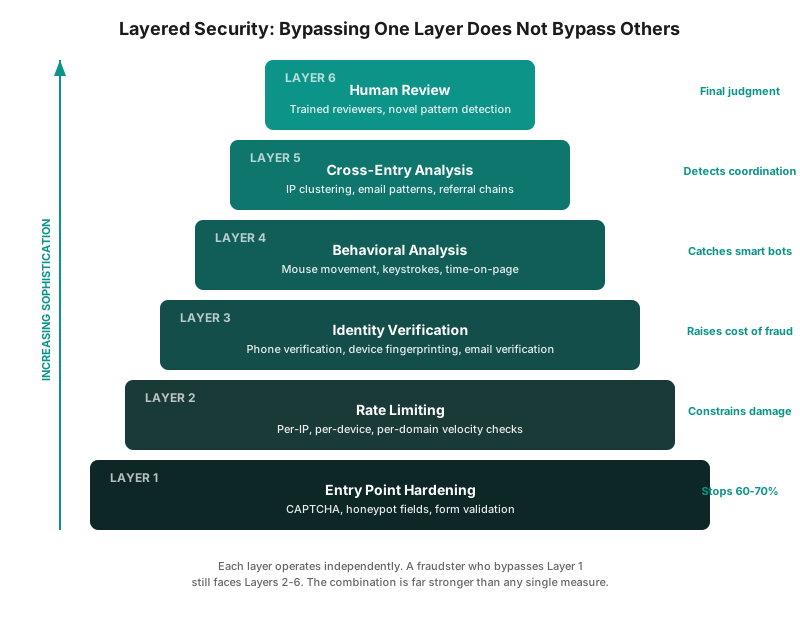
The Six Layers of Contest Security
Effective contest security is a defense-in-depth model. Each layer operates independently but feeds into a shared fraud scoring system, and each layer addresses threats that the others miss.
Layer 1: Entry Point Hardening
This is the front door. It stops automated submissions that make no attempt to appear human.
CAPTCHA remains the first line of defense despite its limitations. Turnstile and reCAPTCHA v3 add the least user friction while filtering the majority of unsophisticated bots. They work best as a baseline filter, catching the high-volume, low-effort attacks so that deeper layers can focus on the sophisticated ones.
Honeypot fields are hidden form fields invisible to human users but filled in by bots that parse the HTML and submit every field. They are trivial to implement, add zero user friction, and catch a surprising number of automated tools. Their effectiveness drops against bots that have been tuned for a specific form, but as a zero-cost addition, they belong in every entry form.
Form validation goes beyond checking that required fields are filled in. It includes format validation (does the email look real, does the phone number have the right number of digits, does the zip code match the state), timing validation (was the form submitted faster than a human could read it), and consistency validation (does the area code match the stated location). These checks catch sloppy automation and data-generated entries.
Layer 2: Rate Limiting
Rate limiting restricts how many entries a single actor can submit within a time window. The challenge is defining "single actor" when fraudsters use techniques to appear as multiple actors.
Per-IP rate limiting is the most common implementation and the easiest to circumvent. Residential proxy services give attackers access to millions of unique IPs. Per-IP limits remain useful for catching unsophisticated attacks but should not be the only mechanism.
Per-device rate limiting is harder to evade. It uses device fingerprints to track submission frequency from the same physical device, even if the IP address changes. Changing a device fingerprint requires specialized tools that most casual fraudsters do not have.
On the email side, per-domain rate limiting throttles entries from domains associated with disposable email services. When 30 entries arrive in an hour from @guerrillamail.com or @tempmail.plus, rate limiting at the domain level is the right move.
The most sophisticated approach is adaptive rate limiting, which adjusts thresholds based on observed traffic patterns. If entry velocity spikes to 10x the normal rate with an unusual geographic distribution, the system tightens limits automatically rather than waiting for a human to notice and respond.
Layer 3: Identity Verification
Identity verification raises the cost and complexity of creating fake entries by requiring the attacker to possess real-world resources.
Email verification (click-to-confirm links) eliminates entries submitted with non-existent email addresses. It does not eliminate entries submitted with disposable addresses, but it forces the attacker to control a working mailbox for every entry. Our bot detection deep dive covers how email verification fits into a broader anti-automation strategy.
Phone verification via SMS or voice one-time codes significantly raises the bar. Virtual phone numbers exist, but they cost money and require management. For high-value campaigns, phone verification is one of the strongest identity signals available. See our phone verification guide for implementation details.
Device fingerprinting creates a unique identifier for each device based on browser configuration, hardware characteristics, installed fonts, screen resolution, and dozens of other attributes. It persists across IP changes and incognito sessions, making it effective at linking multiple entries to the same physical device. See our device fingerprinting guide for how this works in practice.
Layer 4: Behavioral Analysis
Behavioral analysis examines how the user interacts with the entry form, not just what they submit. Humans and bots behave differently in ways that are difficult to fake convincingly at scale.
Mouse movement patterns. Humans move the mouse in curves with natural acceleration and deceleration. They overshoot targets and correct. They pause. Bots either move in straight lines or generate synthetic curves that lack the randomness of real human motor control. Some sophisticated bots do generate realistic mouse movement, but doing so for thousands of entries while maintaining variation is computationally expensive and rarely attempted.
Typing patterns. Humans type at variable speeds, pause between fields to think, make and correct typos. Bots paste data instantly or type at unnaturally consistent speeds. Keystroke dynamics (the timing between key presses) are nearly as unique as fingerprints and extremely difficult to spoof.
Time on page. A human reads the form, considers the fields, and fills them out. This takes time. An entry submitted three seconds after the page loaded was not filled out by a human, regardless of what the CAPTCHA says.
Scroll depth and page interaction. Did the user scroll to the terms and conditions? Did they interact with any page elements besides the form? Bots typically load the page and submit the form without any intermediate interaction.
Layer 5: Cross-Entry Analysis
The first four layers evaluate each entry in isolation. Layer 5 looks across entries to detect patterns that are invisible at the individual level.
IP clustering identifies groups of entries from related IP addresses that share suspicious characteristics. When 40 entries arrive from a /24 subnet with similar form completion times and sequential email addresses, the cluster is almost certainly a single actor. Our IP fraud detection guide covers this in depth.
Email pattern matching detects multi-accounting by identifying entries with systematically generated email addresses. john.smith1@gmail.com through john.smith47@gmail.com is an obvious case, but subtler patterns (variations on the same base name across different providers) can also be detected through fuzzy matching.
Referral chain analysis applies specifically to referral-based promotions. Legitimate referral chains spread organically across social networks. Fraudulent referral chains show tight clustering: a small group of accounts referring each other in circular patterns or a single "hub" account generating dozens of referrals that all share device or IP characteristics.
Layer 6: Human Review
Automated systems make mistakes in both directions. They flag legitimate entries (false positives) and miss clever fraud (false negatives). The final layer is human review of entries that fall in the uncertain middle range.
A HITL (human-in-the-loop) review queue surfaces flagged entries with all available context (fraud score breakdown, IP analysis, device fingerprint matches, behavioral signals, cross-entry pattern matches) and presents them to a human reviewer who makes the final determination.
This layer is essential for two reasons. First, it catches the fraud that automated systems miss, particularly novel attack patterns that have not been seen before. Second, it provides a correction mechanism for false positives, so legitimate entrants are not unfairly excluded. The human reviewers also generate training data that improves the automated layers over time.
Scoring vs. Blocking
The instinct is to build security as a series of gates: pass the CAPTCHA or you are blocked. Pass the rate limit or you are blocked. Pass the email check or you are blocked. This binary approach creates a brittle system that is simultaneously too aggressive (blocking legitimate users who trip one gate) and too permissive (passing fraudsters who clear all gates).
A scoring model is fundamentally different. Every signal (CAPTCHA result, IP classification, device fingerprint matches, behavioral analysis, cross-entry patterns) contributes to a cumulative fraud risk score on a continuous scale (typically 0 to 100). No single signal blocks an entry. Instead, signals accumulate.
An entry from a residential IP with a normal CAPTCHA score, unique device fingerprint, natural mouse movements, and no cross-entry matches scores low (say, 5 out of 100). It passes automatically. An entry from a datacenter IP, with a CAPTCHA score just above the threshold, a device fingerprint that matches three other entries, form completion in 4 seconds, and an email address that follows a sequential pattern scores high (say, 85). It gets rejected automatically. An entry that scores 45 (some suspicious signals but not conclusive) goes to the human review queue.
This approach dramatically reduces false positives while maintaining strong fraud detection. Legitimate users who happen to use a VPN or share a household IP are not blocked because those signals alone do not push the score high enough. Fraudsters who manage to bypass one or two layers still accumulate signals from the layers they cannot bypass.
The Cost-Benefit of Security
Security has a cost beyond the technology spend: it costs user experience. Every additional verification step, every CAPTCHA challenge, every email confirmation adds friction. And friction kills conversion. Legitimate users abandon promotions that make them jump through too many hoops.
The right level of security depends on what is at stake. A campaign distributing $5 off coupons has a low cost per fraudulent entry: if a bot claims a coupon, you lose $5. Aggressive multi-factor verification for a $5 coupon will drive away legitimate participants whose lifetime value far exceeds $5. A light security posture with CAPTCHA, basic rate limiting, and behavioral analysis is appropriate.
A $100,000 grand prize sweepstakes changes the calculus entirely. The cost of a fraudulent winner is $100,000 plus legal fees, regulatory scrutiny, and reputational damage. Every dollar you did not spend on fraud prevention becomes a dollar you wish you had. The cost of a false positive (one legitimate user who abandons entry due to phone verification) is negligible by comparison. Heavy security is justified.
The best systems make this configurable. Brands should be able to dial security up or down based on prize value, campaign type, and risk tolerance, not operate on a one-size-fits-all setting. For a broader discussion of the financial impact of fraud, see our analysis of sweepstakes fraud costs.
Real-Time vs. Batch Analysis
Not all security checks belong at the same point in the pipeline. Some must happen in real time; others are better suited to batch processing.
Real-time checks run at entry submission and must complete in milliseconds. CAPTCHA validation, rate limiting, basic form validation, IP classification, and device fingerprint matching all happen before the user sees a confirmation screen. These checks handle the high-confidence signals, the ones where you are certain enough to block or pass without delay.
Batch analysis runs periodically (hourly, daily) and examines patterns across the full entry corpus. IP clustering, cross-submission email pattern detection, referral chain analysis, and behavioral anomaly detection across entries all work better in batch because they require a dataset large enough to reveal patterns. A single entry from an IP tells you nothing about clustering. A thousand entries from the campaign let you see clusters clearly.
The strongest systems do both. Real-time checks provide immediate protection and instant feedback. Batch analysis provides deep pattern detection and the ability to retroactively flag or void entries that appeared clean in isolation but look suspicious in aggregate. Entries flagged by batch analysis are surfaced in the HITL review queue for human decision.
How Comprizant Handles Security
Comprizant's entry processing pipeline implements all six layers as a configurable, multi-stage system. Entries pass through real-time checks at submission (CAPTCHA via Cloudflare Turnstile, rate limiting, form validation, IP enrichment, device fingerprinting, behavioral analysis), then through batch analysis (IP clustering and cross-submission detection) that runs on an hourly schedule.
Every entry receives a composite fraud score based on 13+ independent signals. Configurable thresholds let brands set the auto-approve, review, and auto-reject boundaries that match their risk tolerance. Flagged entries surface in a HITL review queue with full investigative context: fraud score breakdown, IP history, device matches, behavioral analysis, and cross-entry patterns.
The system is designed so that legitimate participants never encounter additional friction. All fraud detection beyond the initial CAPTCHA is invisible: it runs server-side, analyzes signals passively, and only affects the entry disposition, never the entry experience.
Key Takeaways
Bottom line: CAPTCHA is necessary but stops only casual bots. Professional CAPTCHA-solving services process millions of challenges daily for pennies each.
Every individual security measure has a known bypass. Layered security works because bypassing one layer does not bypass the others. Six layers of defense-in-depth cover the full attack surface: entry point hardening, rate limiting, identity verification, behavioral analysis, cross-entry analysis, and human review.
- Fraud scoring (0-100) is superior to binary blocking. It reduces false positives while maintaining strong detection by accumulating signals across layers.
- Security intensity should match prize value. Over-security kills conversion on low-value campaigns; under-security exposes high-value campaigns to significant losses.
- Combine real-time entry checks with periodic batch analysis. Some patterns are only visible when examining entries in aggregate.
Stop Relying on CAPTCHA Alone
Comprizant's multi-layer security pipeline integrates 13+ fraud signals across six detection stages: configurable per campaign, invisible to legitimate participants, and backed by human review for edge cases.