Sweepstakes Fraud: The 7 Most Common Attacks and How to Prevent Them
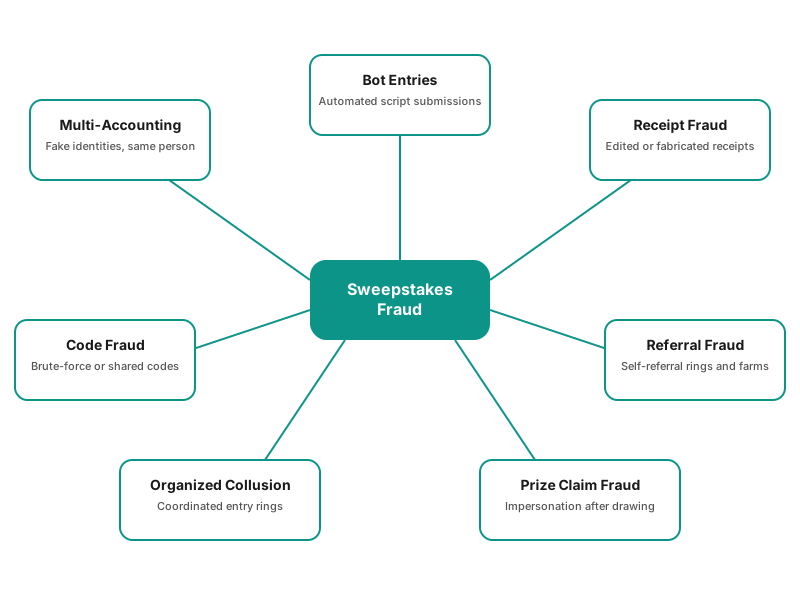
The 7 most common sweepstakes fraud attacks (bot entries, multi-accounting, receipt fraud, code fraud, referral abuse, collusion, and prize claim fraud), with detailed prevention strategies for each.
Fraud is the single biggest operational threat to promotional sweepstakes. A brand that invests six figures in prize budget, creative development, and media spend can see its entire promotion undermined by a handful of bad actors operating scripts, fake accounts, or organized entry rings.
The problem is growing. As sweepstakes move online and prize values increase, so does the sophistication of fraudsters targeting them. What was once limited to people mailing in extra entries has evolved into a complex ecosystem of bots, proxy networks, receipt fabrication tools, and professional sweepstakes fraud services.
This guide covers the seven most common fraud attack vectors in promotional sweepstakes, the specific signals that indicate each type, and the prevention strategies that work. If you run promotions of any scale, understanding these threats is not optional. The brands that get burned are the ones that assumed it would not happen to them.
This article is for informational purposes only and does not constitute legal advice. Consult with a qualified attorney for guidance specific to your promotion.
The Cost of Ignoring Fraud
Sweepstakes fraud costs more than money. It poisons the entire promotion.
Legitimate participants lose trust. When entrants suspect that a promotion is overrun with bots or fake entries, engagement drops. People stop entering, stop sharing, and stop viewing the brand positively. A sweepstakes that feels rigged, even if the drawing itself is fair, damages the brand it was meant to build.
Prize budgets get wasted on fraudulent winners. Every fraudulent entry that makes it into the drawing pool dilutes the odds for real participants. If a bot operator submits 10,000 entries and a legitimate entrant submits 1, the math is not in the legitimate entrant's favor. When a fraudulent entry wins, the prize goes to someone who provides zero brand value.
Regulatory scrutiny intensifies. State attorneys general and the FTC take an interest when consumers complain that a promotion was unfair. If fraud undermines the integrity of a sweepstakes, the sponsor faces potential enforcement action on top of the reputational damage. As covered in our complete compliance guide, sponsors have a legal obligation to conduct promotions fairly.
Data quality collapses. One of the primary business objectives of a sweepstakes is capturing real consumer data: names, emails, purchase behavior, preferences. Fraudulent entries fill your database with junk data that pollutes analytics, inflates engagement metrics, and degrades the value of every legitimate lead you collected.
For a deeper analysis of the financial and operational impact, see our guide on the true cost of sweepstakes fraud.
1. Bot Entries
Bot entries are the most common and most scalable form of sweepstakes fraud. A single operator running automated scripts can submit thousands of entries per hour without ever touching a browser.
How It Works
Bot operators write scripts that programmatically fill and submit entry forms, ranging from simple HTTP requests with curl or Python's requests library to sophisticated browser automation using tools like Selenium, Puppeteer, or Playwright. Modern bots can rotate IP addresses using residential proxy networks, randomize user agents, and even solve CAPTCHAs using third-party solving services that charge $2-3 per thousand solves.
The economics are straightforward. If a sweepstakes offers a $10,000 prize and a bot operator can submit 50,000 entries for under $100 in proxy and CAPTCHA-solving costs, the expected value calculation heavily favors the bot operator, especially when they are running against multiple promotions simultaneously.
Signs of Bot Activity
The first thing you notice is the timing. Bot entries arrive at precise intervals (every 2.3 seconds, for example) rather than the irregular cadence of human behavior. Form completion times clock in under 3 seconds for forms that take a real person 30-60 seconds. No one fills out a name, email, address, and phone number in two seconds.
Beyond timing, headless browsers leave technical fingerprints. They often lack the full set of browser APIs that real browsers expose: missing WebGL rendering, incomplete canvas fingerprints, absent plugin lists. Bot-generated data also follows suspiciously consistent patterns in how names, addresses, and phone numbers are formatted, unlike the natural variation in human input. And the network signals are telling: hundreds of entries from the same /24 subnet within minutes point to a single operator cycling through addresses.
Prevention
A CAPTCHA is a speed bump, not a wall. It stops the laziest attackers and nothing else. Determined operators use solving services to bypass it. Effective prevention requires layering CAPTCHA with behavioral analysis (is the user's mouse movement and typing pattern consistent with a human?), device fingerprinting (is the same device submitting under different identities?), and rate limiting (enforce reasonable submission velocity per IP, device, and email domain).
For a deep dive on bot detection techniques, see our guide on bot detection in contests and sweepstakes.
2. Multi-Accounting
Multi-accounting is when a single person creates multiple identities to submit more entries than the rules allow. It is less scalable than bots but harder to detect because each individual submission looks legitimate.
How It Works
A person creates several email addresses (john.smith1@gmail.com, johnsmith2@gmail.com, j.smith.promo@yahoo.com) and submits separate entries for each. More sophisticated operators use different browsers, clear cookies between submissions, and use a VPN to rotate IP addresses. Some maintain libraries of fake identities with consistent names, addresses, and phone numbers.
In promotions that allow one entry per day, a multi-accounter with 10 email addresses gets 10x the daily entries of a legitimate participant. Over a 30-day promotion, that is 300 entries versus 30.
Signs of Multi-Accounting
- Shared IP addresses across multiple accounts. If five "different" people enter from the same residential IP within an hour, that warrants investigation.
- Similar email patterns. Variations on the same name, sequential numbers appended to a base address, or multiple entries from the same uncommon email domain.
- Same device fingerprint across accounts. This is the strongest signal. A person can change their email, name, and IP address, but changing their device fingerprint is significantly harder.
- Overlapping personal details. Same phone number, same ZIP code, similar names with slight variations.
Prevention
Device fingerprinting is the most effective countermeasure. When the same browser fingerprint appears across multiple entries with different identity information, that is a strong fraud signal. Combine fingerprinting with IP analysis (flagging multiple entries from the same IP), email domain analysis (detecting disposable email services), and phone verification (requiring a unique, verified phone number per entry).
For more on IP-based fraud detection, see our guide on IP fraud detection in sweepstakes.
3. Receipt Fraud
Receipt fraud targets purchase-verification promotions where entry requires uploading a photo of a store receipt. As brands increasingly use receipt-based promotions to tie marketing spend to actual sales, fraudsters have developed correspondingly sophisticated methods to fabricate proof of purchase.
How It Works
Receipt fraud takes several forms, each with different levels of sophistication.
Edited receipts. A person buys a qualifying product, photographs the receipt, then uses image editing software to change the date (to extend eligibility), add line items (to meet purchase thresholds), or modify the retailer name. Basic edits are crude (visible font mismatches, misaligned text), but skilled editors produce receipts that are difficult to distinguish visually from originals.
Fabricated receipts. Fraudsters create receipts from scratch using receipt generator tools available online. These tools produce realistic-looking receipts for major retailers, complete with correct formatting, logos, and tax calculations. Some services sell custom receipt templates for $5-20.
Reused receipts. The same legitimate receipt is submitted to multiple promotions, or shared among a group of people who each submit it as their own. Receipt-sharing forums and social media groups make this easy to do at scale.
Receipt-sharing networks. Online communities where members share photos of qualifying receipts for others to submit. A single legitimate receipt can generate dozens of fraudulent entries across different accounts.
Signs of Receipt Fraud
- Metadata inconsistencies. Digital photos contain EXIF data including the device model, timestamp, and sometimes GPS coordinates. A receipt dated January 5 with a photo timestamp of March 15 is suspicious. A receipt from a Walmart in Ohio with GPS data from Florida is a red flag.
- Pixel-level editing artifacts. Image analysis can detect areas where pixels have been manipulated: clone stamping, content-aware fill, or simple copy-paste of text elements.
- Identical receipt images across entries. Hash-based or perceptual duplicate detection catches reused receipts, even when the image has been slightly cropped, rotated, or recompressed.
- Formatting anomalies. Fabricated receipts often get subtle details wrong: incorrect tax rates for the listed store location, line item formatting that does not match the retailer's actual POS system, or fonts that the retailer does not use.
Prevention
Effective receipt validation combines OCR-based field extraction (verifying the retailer, products, date, and amount match the promotion requirements) with AI-powered image analysis (detecting editing artifacts and fabrication) and duplicate detection (catching reused receipts across submissions). Human review remains essential for edge cases that automated systems cannot resolve with confidence.
For a complete overview of receipt-based promotions and their challenges, see our receipt upload promotions guide. For details on the technology behind automated validation, see our guide on receipt validation technology.
4. Code Fraud
Code-based promotions, where entry requires submitting a unique code found on product packaging, in-store displays, or marketing materials, face a distinct set of fraud challenges centered on code security.
How It Works
Brute-force attacks. If codes follow a predictable pattern (sequential numbers, short alphanumeric strings), attackers can systematically guess valid codes. A 6-character alphanumeric code has about 2 billion possible combinations, which sounds large but can be exhausted by a script making thousands of attempts per minute against an unprotected endpoint.
Code sharing. Legitimate codes are posted on deal sites, social media groups, and forums. A single code intended for one redemption gets shared to thousands of people. Even single-use codes get shared: the first person to redeem it wins, but the sharing behavior degrades the promotion experience for others.
Code generation. If an attacker reverse-engineers the code generation algorithm (which is possible when codes follow simple patterns like sequential numbers with a checksum), they can generate valid codes without ever purchasing the product.
Signs of Code Fraud
- High-velocity code attempts. Dozens of code submissions from the same IP or device within minutes, most of which are invalid, indicating a brute-force attack.
- Codes appearing on coupon and deal sites. Monitoring known deal-sharing platforms for your promotion's codes can reveal leaks early.
- Geographic impossibility. Codes distributed exclusively in retail stores in the Midwest being redeemed by users geolocated to Eastern Europe.
- Redemption velocity exceeding distribution. If you distributed 50,000 codes but see 200,000 redemption attempts within the first week, codes are being shared or fabricated.
Prevention
Code security starts at generation. High-entropy codes (16+ characters, mixed case, alphanumeric with special characters) make brute-forcing computationally infeasible. Rate limiting on the redemption endpoint (maximum 3 attempts per IP per minute, for example) blocks automated guessing. Immediate invalidation on first redemption prevents code sharing from generating multiple entries. Code pool monitoring (tracking redemption velocity, geographic distribution, and error rates) enables early detection of systematic attacks.
For more on code-based promotions and code pool management, see our guide on coupon campaigns.
5. Referral Fraud
Referral mechanics add a powerful growth loop to sweepstakes but also create a new attack surface. When participants earn bonus entries or rewards for referring friends, fraudsters find ways to game the referral system.
How It Works
Self-referral rings. A person creates multiple accounts, uses one to generate a referral link, then "refers" their other accounts. Each fake referral earns the primary account additional entries or milestone rewards. With 20 fake accounts and a promotion that grants 5 bonus entries per referral, that is 100 extra entries from zero real referrals.
Referral farms. Organized groups, sometimes operating from the same location, create accounts and refer each other in circular patterns. Unlike self-referral, this involves multiple real people, making detection harder. Some referral farm services advertise online, charging a fee per referral generated.
Fake referral accounts. The "referred" accounts complete the minimum required action (submitting an entry) but have no genuine interest in the promotion. They exist solely to trigger the referral reward. These accounts never engage with the brand again after their single entry.
Signs of Referral Fraud
- Referral chains with identical device fingerprints. The strongest signal. If a referrer and five of their referees all have the same browser fingerprint, they are the same person on the same device.
- Burst of referrals from the same IP. A legitimate referrer might generate 1-3 referrals per day. Ten referrals from the same IP within an hour is suspicious.
- New accounts that never engage beyond the referral. Referred users who enter exactly once, with minimal time on the entry page and no subsequent visits, are likely fraudulent.
- Circular referral patterns. A refers B, B refers C, C refers A, or more complex patterns that ultimately form closed loops.
Prevention
Delayed attribution is one of the most effective countermeasures. Instead of crediting the referral immediately when the referee submits an entry, wait to verify that the referee is a genuine participant: did they spend a reasonable amount of time on the entry page? Did they exhibit human behavioral patterns? Did they return to the promotion again? Only after passing these checks should the referral reward be credited.
Device fingerprinting catches self-referral rings by identifying when the same device generates both the referral and the referred entry. Referral quality scoring assigns a confidence score to each referral based on multiple signals (device uniqueness, behavioral patterns, engagement depth) and only credits high-confidence referrals.
For a complete guide to referral mechanics and compliance, see our referral sweepstakes guide.
6. Collusion and Organized Fraud
Collusion involves groups coordinating their entries to increase collective odds, sometimes at a professional level. This category includes professional sweepstakes entrants ("sweepers"), entry-selling services, and organized fraud rings.
How It Works
Professional sweepers. A subculture of people who enter sweepstakes as a primary activity. While entering many sweepstakes is not inherently fraudulent, some sweepers use automation, multiple accounts, and aggressive entry strategies that violate promotion rules. Sweeper communities share tips on bypassing fraud detection, maximizing entries, and identifying promotions with weak security.
Entry-selling services. Some operators sell sweepstakes entries, charging a fee to submit entries on behalf of clients. The operator uses automation and bulk submission techniques, then splits any winnings with the client. This violates virtually every sweepstakes' official rules, which prohibit third-party entry submission.
Organized fraud rings. The most sophisticated threat. Groups operating across multiple locations and devices coordinate their entries to maximize the number of entries in the drawing while evading detection. They share techniques for defeating fraud prevention measures and adapt their strategies as defenses evolve. Some rings operate as businesses, targeting high-value promotions across brands.
Signs of Collusion
The classic tell is geographic clustering: an unusual concentration of entries from a specific area that does not correlate with marketing distribution or population density. Coordinated entry timing is another signal: multiple entries arriving in tight temporal clusters suggest an organized effort rather than organic participation.
Look deeper and you find shared characteristics across entries: similar email naming conventions, overlapping address ranges, or consistent entry behavior patterns across accounts that claim to be different people. Network analysis is the most powerful tool here. When you map referral and social graph connections and find dense interconnections among a group of entrants (they all refer each other, share entry links in the same group, or exhibit social graph clustering), collusion is likely.
Prevention
Cross-submission analysis is the primary defense. By examining relationships between entries (shared IPs, device fingerprints, behavioral patterns, temporal correlations, geographic clusters), it is possible to identify groups of entries that are likely connected, even when individual entries look legitimate in isolation.
Behavioral clustering algorithms can identify entries that share unusual patterns. IP network analysis maps relationships between entries to detect organized activity. These techniques work because collusion inherently creates detectable patterns: the coordination that makes it effective also makes it visible to systems designed to look for it.
For more on IP-based detection and network analysis, see our guide on IP fraud detection in sweepstakes.
7. Prize Claim Fraud
Prize claim fraud occurs after the drawing, when someone attempts to fraudulently claim a prize they did not legitimately win. This is less common than entry fraud but involves higher individual stakes, especially for prizes valued at $5,000 or more.
How It Works
Winner impersonation. A fraudster learns the identity of a winner (through social media announcements, data breaches, or insider information) and contacts the sponsor pretending to be the winner, providing fabricated identification documents.
False identity documents. The actual winner provides forged identification, sometimes to hide their real identity (for privacy reasons) but sometimes to enable tax evasion: they want to claim the prize under a different SSN to avoid the tax liability.
Tax evasion schemes. Winners attempt to structure prize claims to avoid or reduce the tax burden. This can involve claiming the prize under a nominee or shell entity, requesting the prize be split among multiple people at values below reporting thresholds, or providing a false W-9. As outlined in our official rules guide, proper winner verification and tax compliance are sponsor obligations, not optional practices.
Rush-to-claim pressure. Fraudsters often try to create urgency: pressing for immediate prize shipment before verification is complete, claiming they are traveling and need the prize sent to a different address, or threatening legal action for delays.
Signs of Prize Claim Fraud
- Contact information that does not match entry data. The "winner" provides a different phone number, email, or address than what was submitted with the winning entry.
- Reluctance to provide required documentation. Legitimate winners may grumble about paperwork, but fraudsters actively resist providing W-9 forms, government-issued ID, or signed affidavits.
- Inconsistent identity details. Minor discrepancies in name spelling, date of birth, or address between the entry, the prize claim, and the identification documents.
- Unusual urgency. Insistence on immediate prize delivery without completing standard verification steps.
Prevention
Multi-step verification is essential for high-value prizes. Require the winner to verify their identity through multiple channels: email verification, phone verification, government-issued ID, and a signed affidavit/release. For prizes above the IRS reporting threshold ($2,000), W-9 collection is both a legal requirement and a fraud prevention measure.
Cross-reference the prize claim information against the original entry data. Verify that the name, email, phone number, and address are consistent. For very high-value prizes ($25,000+), consider using a professional prize fulfillment service that includes identity verification as part of their process.
For more on the prize fulfillment process and winner verification, see our prize fulfillment guide.
The Layered Defense Approach
No single fraud prevention measure stops all attacks. Bots that bypass CAPTCHA are caught by behavioral analysis. Multi-accounters who rotate IPs are caught by device fingerprinting. Receipt fraudsters who produce visually perfect fakes are caught by metadata analysis and duplicate detection. Each layer catches what the previous layers missed.
An effective fraud prevention architecture works like this:
Layer 1: Entry-level validation. CAPTCHA, honeypot fields, basic rate limiting. Stops the lowest-effort attacks. Think of this as the front door lock: it deters casual intruders but will not stop a determined attacker.
Layer 2: Behavioral analysis. Mouse movements, keystroke dynamics, time-on-page, form interaction patterns. Catches sophisticated bots that pass CAPTCHA. This layer works because human behavior is complex and expensive to simulate accurately.
Layer 3: Device fingerprinting. Browser and hardware fingerprints that persist across sessions and accounts. Primary defense against multi-accounting and self-referral. Effective because changing a device fingerprint requires changing the actual device or using specialized anti-fingerprinting tools.
Layer 4: IP intelligence. Datacenter IP detection, VPN/proxy detection, residential proxy identification, geographic plausibility. Catches entries routed through anonymizing infrastructure. Complements device fingerprinting by adding a network-level identity signal.
Layer 5: Cross-submission analysis. Relationship mapping across entries: shared characteristics, temporal patterns, referral networks, geographic clusters. This is where organized fraud and collusion become visible. Individual entries that look clean in isolation reveal their connections when analyzed collectively.
Layer 6: Human review. Entries that score above configurable fraud thresholds but below automatic rejection are routed to a human review queue. Trained reviewers examine flagged entries with full context (all signals, related entries, submission patterns) and make final accept/reject decisions.
The key insight is that layers 1-4 evaluate each entry independently, while layer 5 evaluates entries in relationship to each other. Both perspectives are necessary. And layer 6 provides the judgment that automated systems cannot replicate, especially for novel fraud patterns that do not yet have established detection rules.
For a comprehensive overview of security best practices across all layers, see our guide on contest and sweepstakes security.
How Comprizant Handles Fraud
Comprizant's trust and safety pipeline implements the layered defense approach described above. Every entry passes through a multi-stage processing pipeline that evaluates fraud risk in real time.
Configurable fraud thresholds. Every campaign can set its own tolerance levels for fraud signals. A high-value sweepstakes with a $100,000 grand prize warrants stricter thresholds than a low-value promotion. Sponsors control the trade-off between security and user friction.
13+ fraud signals across 4 detection adapters. The pipeline evaluates entries across four specialized adapters: cross-submission analysis (identifying related entries), device fingerprinting (detecting multi-accounting), phone verification (confirming real phone numbers), and behavioral analysis (distinguishing humans from bots). Each adapter produces multiple signals that feed into the overall fraud score.
HITL review queue. Entries that exceed fraud thresholds but are not obvious rejects are routed to a human review queue. The investigation UI provides reviewers with full context (all fraud signals, related entries, submission timeline, device and IP history) so they can make informed decisions quickly.
Tiered trust and safety options. Sponsors choose the level of fraud protection appropriate for their campaign. A basic tier includes CAPTCHA, rate limiting, and duplicate detection. Higher tiers add behavioral analysis, device fingerprinting, cross-submission analysis, and dedicated human review. This structure means fraud prevention investment scales with the stakes of the promotion.
Key Takeaways
- Bot entries are the highest-volume threat but also the most detectable with layered defenses. CAPTCHA alone is not enough. Combine it with behavioral analysis, fingerprinting, and rate limiting.
- Multi-accounting requires device-level detection. IP blocking is insufficient because IPs can be rotated. Device fingerprinting provides a more persistent identity signal.
- Receipt and code fraud target purchase-verification promotions specifically. These attack types require domain-specific defenses: OCR validation, image analysis, high-entropy codes, and code pool monitoring.
- Referral fraud exploits the incentive structure. Delayed attribution and referral quality scoring prevent the easiest path to abuse without degrading the experience for legitimate referrers.
- Organized fraud is the hardest to detect because individual entries appear legitimate. Cross-submission analysis (examining relationships between entries rather than evaluating entries in isolation) is the primary defense.
- Prize claim fraud happens after the drawing and requires rigorous identity verification, especially for high-value prizes.
- No single measure is sufficient. Effective fraud prevention uses multiple layers, each catching what the previous layers missed, with human review as the final backstop.
Protect Your Next Promotion
Comprizant's multi-layer trust and safety pipeline detects and prevents fraud across all seven attack vectors covered in this guide. Configurable thresholds, 13+ fraud signals, and a HITL review queue give you control over your promotion's integrity without adding friction for legitimate participants.
Get started with Comprizant and launch your next sweepstakes with confidence.