The Complete Guide to Sweepstakes Compliance in 2026
Everything brands need to know about running legally compliant sweepstakes, from federal requirements and state registration to official rules, AMOE, and the new $2,000 tax threshold.
Running a sweepstakes is one of the most effective ways to drive engagement, collect leads, and build brand awareness. But promotions in the United States are governed by a complex web of federal and state laws, and getting compliance wrong can result in fines, lawsuits, and reputational damage that far outweigh any marketing benefit.
This guide covers everything you need to know to run a legally compliant sweepstakes in 2026, including the changes that took effect this year.
What Makes a Sweepstakes Legal?
A sweepstakes is a promotional drawing where winners are selected by random chance. Under U.S. law, a legal sweepstakes must satisfy a critical test: it cannot combine all three elements of an illegal lottery.
An illegal lottery has three components:
- Prize: something of value awarded to winners
- Chance: winners are selected randomly
- Consideration: participants must pay or provide something of value to enter
A sweepstakes always has prize and chance. The way to keep it legal is to eliminate consideration, meaning you must provide a free way to enter. This is the foundation of the "No Purchase Necessary" requirement.
If you instead eliminate chance (winners are determined by skill or merit), you have a contest, which has different legal requirements. If you eliminate prize (no one wins anything), you have a survey or poll. Understanding these distinctions is essential. We cover them in depth in our sweepstakes vs. contest vs. lottery guide.
Federal Requirements
FTC Regulation
The Federal Trade Commission (FTC) enforces truth-in-advertising laws that apply to sweepstakes promotions. Key requirements include:
- Material terms must be clearly disclosed. Prize values, odds of winning, entry deadlines, and eligibility restrictions cannot be buried in fine print. They must be presented clearly and conspicuously.
- No deceptive practices. You cannot misrepresent the nature of the promotion, the prizes, or the odds. Saying "You may have already won!" when the winner hasn't been determined is the kind of practice that draws FTC attention.
- Endorsement disclosures. If influencers or brand ambassadors promote your sweepstakes, the material connection between the promoter and the brand must be disclosed. The FTC's updated Endorsement Guides (revised in 2023) specifically address social media promotions.
CAN-SPAM and TCPA
If you plan to communicate with entrants via email or text message, you must comply with:
- CAN-SPAM Act: Marketing emails must include a physical address, clear identification as advertising, and a working unsubscribe mechanism.
- TCPA (Telephone Consumer Protection Act): Text message marketing requires prior express written consent. Entering a sweepstakes does not automatically grant consent to receive marketing texts unless explicitly disclosed and agreed to.
COPPA (Children's Online Privacy Protection Act)
If your sweepstakes may attract participants under 13, COPPA applies. You must obtain verifiable parental consent before collecting personal information from children. Many brands avoid COPPA complexity by setting a minimum age of 18 (or 21 for alcohol-related promotions).
The No Purchase Necessary Rule
The "No Purchase Necessary" (NPN) requirement is the single most important compliance rule. Every sweepstakes that involves any purchase element (buying a product, making a donation, paying a subscription fee) must provide a free alternative method of entry (AMOE) that offers the same chance of winning.
What Counts as Consideration?
Courts have interpreted "consideration" broadly. Beyond direct purchases, paid subscriptions required to access the entry form, significant time or effort beyond what's reasonable (like requiring a 500-word essay), social media follows or shares required as a condition of entry (in some jurisdictions), and mandatory app downloads with registration can all constitute consideration.
The gray area catches more brands than the obvious cases. If you're unsure whether your entry mechanic creates consideration, it probably does.
Designing a Compliant AMOE
The most common AMOE is a mail-in entry. A compliant mail-in AMOE must:
- Be clearly disclosed in the official rules and on all promotional materials
- Provide the same number of entries and same chance of winning as the paid method
- Not be unduly burdensome (the cost of a stamp and envelope is acceptable; requiring notarized documents is not)
- Be available for the entire promotion period
Online AMOEs are becoming more common and are generally acceptable, but they must not require any purchase, payment, or account creation beyond what's needed to submit the entry.
For a deep dive on AMOE design, see our Alternative Method of Entry guide.
State Registration and Bonding
While federal law sets the baseline, several states impose additional requirements that catch many brands off guard. The three states with the most significant registration requirements are New York, Florida, and Rhode Island.
New York
New York requires registration and bonding for any sweepstakes with a total prize value exceeding $5,000.
- Form: DOS-0255-F (Registration) and DOS-0261-F (Surety Bond)
- Filing deadline: At least 30 days before the promotion start date
- Bond amount: Equal to the total value of all prizes offered
- Winners list: Must be filed within 90 days after the promotion ends
- Filing fee: $150 (2026 schedule)
Read our complete New York filing guide →
Florida
Florida requires registration for sweepstakes with a total prize value exceeding $5,000.
- Form: FDACS-10951
- Filing deadline: At least 7 days before the promotion start date
- Bond/trust: Surety bond or trust account covering the total prize value
- Winners list: Must be provided within 60 days of a request
- Filing fee: $100
Read our complete Florida filing guide →
Rhode Island
Rhode Island requires registration for in-store promotions where the total prize value exceeds $500.
- Form: Form 660
- Filing deadline: Before the promotion begins
- Bond: Not required
- Scope: Applies primarily to point-of-sale promotions; purely online sweepstakes are generally exempt
Read our complete Rhode Island filing guide →
Other States to Watch
While NY, FL, and RI are the primary registration states, other states have requirements worth noting:
- California: While no registration is required, California's legal code requires specific disclosures in official rules and has strong consumer protection enforcement.
- Maine: Requires registration for promotions that require a purchase to enter (which technically shouldn't apply to a compliant sweepstakes with AMOE, but some interpretations are broader).
- Arizona: Requires disclosure of odds of winning and total prize value.
- Maryland: Charitable gaming laws may apply if the sweepstakes benefits a nonprofit.
For a full 50-state breakdown, see our state registration requirements guide.
Official Rules Requirements
Every sweepstakes must have official rules that serve as the legal contract between the sponsor and participants. This is the single most common compliance failure we see, and the easiest to fix.
What Must Be Included
At minimum, your official rules should cover:
- Eligibility: Who can enter (age, residency, employee exclusions)
- Sponsor identification: Full legal name and address of the sponsoring entity
- Promotion period: Exact start and end dates with time zones
- How to enter: All entry methods, including the free AMOE
- Entry limits: How many times each person can enter and through which methods
- Prize descriptions: Each prize tier, approximate retail value (ARV), and quantity
- Winner selection: How and when winners will be chosen (random drawing, instant win, etc.)
- Odds of winning: Either stated odds or a formula ("Odds depend on the number of eligible entries received")
- Winner notification: How winners will be contacted and the response deadline
- Prize fulfillment: How prizes will be delivered and any conditions (verification, affidavit, tax forms)
- General conditions: Liability release, publicity rights, dispute resolution, governing law
- Winners list: How to obtain a list of winners after the promotion ends
Common Official Rules Mistakes
- Using a generic template without state-specific provisions. New York, Florida, and California each require specific disclosures.
- Failing to specify the AMOE clearly. The AMOE must appear in the rules and on promotional materials, not buried in a footnote.
- Vague prize descriptions. "Gift card" is not sufficient. Specify "One (1) $500 Visa gift card (ARV: $500)."
- Missing the "void where prohibited" clause. While you should list specific states you're excluding, this catch-all clause provides additional protection.
- No dispute resolution mechanism. Specify governing law (typically the sponsor's state) and whether disputes go to arbitration or court.
For a complete guide with examples, see our official rules writing guide.
Tax Reporting: The New $2,000 Threshold
One of the most significant changes for 2026 is the new 1099-MISC reporting threshold for prizes. Effective January 1, 2026, the threshold for issuing a 1099-MISC for prize winnings has been raised from $600 to $2,000.
What This Means for Sponsors
- Prizes valued at $2,000 or more require the sponsor to collect a W-9 from the winner and issue a 1099-MISC to both the winner and the IRS.
- Prizes valued under $2,000 do not require 1099 reporting (though the winner is still technically required to report the income).
- This change reduces administrative burden for brands running promotions with moderate prize values.
Best Practices
Always collect winner information regardless of prize value. You may need it for regulatory purposes even if 1099 reporting isn't triggered. Your official rules should also disclose tax obligations so winners understand they are responsible for taxes on prize values.
One detail many sponsors miss: if the same person wins multiple prizes that together exceed $2,000, reporting may still be required. Track cumulative prizes, not just individual awards.
Void Where Prohibited vs. State-by-State Planning
Many brands default to the "void where prohibited" clause and hope for the best. This is legally risky for several reasons:
- It doesn't protect you from registration requirements. You still need to register in NY and FL even if your rules say "void where prohibited." The registration obligation is triggered by offering the sweepstakes to residents of those states.
- It's vague. If a dispute arises, a court may require you to prove you actually knew which states prohibited your promotion and took steps to exclude them.
- It can limit your reach unnecessarily. Some brands exclude entire states out of caution when they could comply with that state's requirements instead.
A better approach: explicitly list the states where your promotion is void, and comply with the registration requirements for every state you include.
Timeline for a Compliant Sweepstakes
Planning compliance into your timeline from the start prevents last-minute scrambles. Here is a recommended timeline:
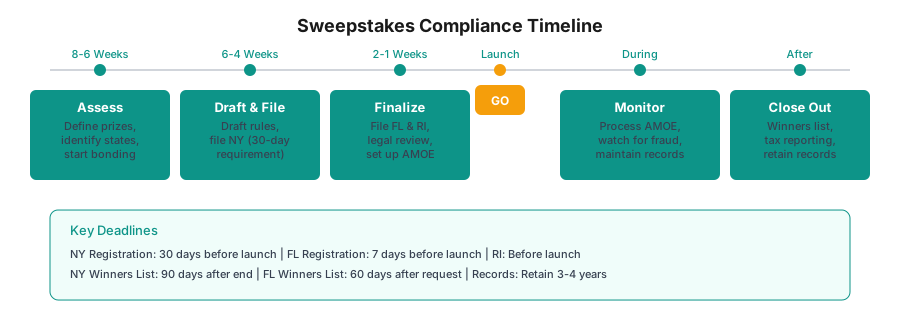
8-6 Weeks Before Launch
- Define prize structure and calculate total ARV
- Determine eligible states
- Identify registration and bonding requirements
- Begin bonding process (can take 2-4 weeks for large prizes)
6-4 Weeks Before Launch
- Draft official rules
- Submit NY registration (30-day requirement)
- Begin insurance/indemnification if needed for high-value prizes
2-1 Weeks Before Launch
- Submit FL registration (7-day requirement)
- Submit RI registration if applicable
- Finalize official rules with legal review
- Set up AMOE processing (mailing address, entry logging)
During the Promotion
- Process AMOE entries on the same schedule as other entry methods
- Monitor for fraud and suspicious entry patterns
- Maintain records of all entries, communications, and prize fulfillments
After the Promotion
- Select and verify winners per official rules
- Collect W-9 forms for prizes at or above the $2,000 threshold
- Fulfill prizes within the timeframe stated in official rules
- File NY winners list (within 90 days)
- Respond to FL winners list requests (within 60 days)
- Retain records for at least 3-4 years (statute of limitations varies by state)
Common Compliance Mistakes to Avoid
1. Treating Social Media Shares as Free Entry
Requiring participants to follow your account, share a post, or tag friends as a condition of entry can be problematic. Some jurisdictions consider mandatory social actions as consideration, which could transform your sweepstakes into an illegal lottery. The safest approach: offer social actions as bonus entries rather than requirements, and always provide a non-social AMOE.
2. Running Without Official Rules
"We'll figure out the rules later" is surprisingly common, and extremely dangerous. Without official rules in place before launch, you have no legal framework for the promotion. This leaves you exposed to complaints, disputes, and regulatory action.
3. Ignoring State Registration Deadlines
New York's 30-day advance filing requirement catches many brands. If you're planning a national promotion, NY registration should be one of the first items on your timeline.
4. Assuming Online-Only Means No State Rules Apply
State sweepstakes laws generally apply based on where participants reside, not where the promotion is hosted. An online-only sweepstakes open to all 50 states still triggers NY and FL registration if the total ARV exceeds $5,000.
5. Forgetting Post-Promotion Obligations
The promotion doesn't end when the entry period closes. Winners lists, tax reporting, record retention, and responding to regulatory inquiries are all post-promotion obligations that brands frequently overlook.
How Compliance Automation Changes the Economics
Historically, sweepstakes compliance required hiring a specialized law firm or administration agency, often costing $5,000-$15,000 per promotion. This put proper compliance out of reach for many brands, especially those running multiple promotions per year.
Modern compliance automation platforms change this equation. AI-powered systems can generate state-specific official rules in minutes by combining your campaign parameters with an up-to-date legal knowledge base. Registration tracking flags which states require filing based on your prize structure and eligible states, with deadline alerts and form pre-filling.
Beyond rules and registration, these platforms support AMOE processing (logging mail-in entries alongside digital entries), AI compliance review that flags issues like missing disclosures or AMOE imbalances, and audit trails that document every compliance action for regulatory defense.
This doesn't replace legal counsel for complex situations, but it makes baseline compliance accessible, consistent, and affordable for brands of all sizes.
Key Takeaways
- A legal sweepstakes eliminates consideration by providing a free method of entry (AMOE) with equal chances of winning.
- New York, Florida, and Rhode Island have state registration requirements triggered by prize value thresholds.
- Official rules are non-negotiable: they must be complete, state-specific, and in place before launch.
- The 2026 tax threshold is now $2,000, up from $600, reducing administrative burden for moderate-value prizes.
- "Void where prohibited" is not a compliance strategy. Know which states you're operating in and comply with their specific requirements.
- Build compliance into your timeline from the start, especially the 30-day NY filing requirement.
- Automation makes compliance accessible without the $10,000+ cost of traditional administration agencies.
Ready to run your next sweepstakes with confidence? Get started with Comprizant: compliance automation built for modern promotions.