Sweepstakes vs. Contest vs. Lottery: Legal Differences That Matter
Understanding the legal distinctions between sweepstakes, contests, and lotteries is essential for running compliant promotions. This guide breaks down prize, chance, and consideration.
The words "sweepstakes," "contest," "lottery," "giveaway," and "raffle" are used interchangeably in everyday conversation. But in the eyes of the law, they describe fundamentally different types of promotions with different legal requirements, and using the wrong one can expose your brand to serious liability.
This guide breaks down the legal distinctions between sweepstakes, contests, and lotteries, explains where informal terms like "giveaway" and "raffle" fit, and helps you understand which rules apply to your promotion.
This article is for informational purposes only and does not constitute legal advice. Consult with a qualified attorney for guidance specific to your promotion.
The Three Elements: Prize, Chance, and Consideration
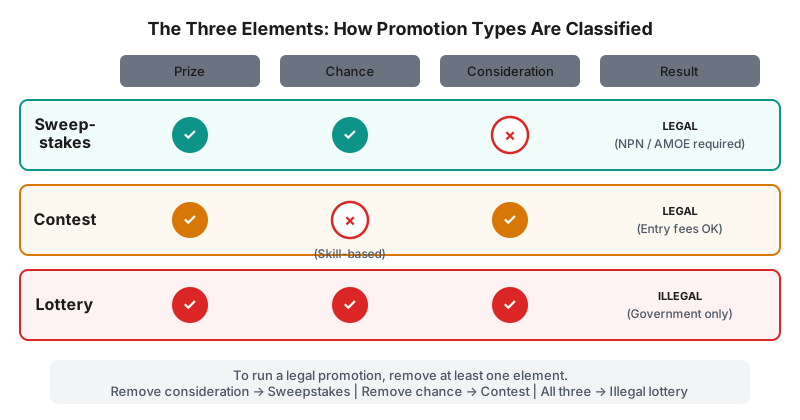
Every promotional classification in U.S. law comes down to three elements:
- Prize: Something of value is awarded to one or more participants. This can be cash, physical products, gift cards, travel, experiences, or anything with monetary worth.
- Chance: The outcome is determined by luck or random selection rather than skill or merit. A random drawing is chance. A spin-the-wheel game is chance. Picking a name out of a hat is chance.
- Consideration: Participants must give something of value to enter. This includes direct payments, purchases, subscription fees, and in some interpretations, substantial time or effort.
The combination of these three elements determines whether your promotion is a sweepstakes, a contest, or an illegal lottery. Getting this classification right is the foundation of every other compliance decision you will make.
Sweepstakes: Prize + Chance (No Consideration)
A sweepstakes is a promotion where winners are selected by random chance, and participants are not required to pay or provide consideration to enter.
How Sweepstakes Work
Winners are chosen by random drawing, instant win game, or other chance-based mechanism. Entry must be free: the "No Purchase Necessary" (NPN) requirement is the defining legal characteristic. If a purchase element exists (buy a product, upload a receipt), a free Alternate Method of Entry (AMOE) must be provided with equal odds of winning.
Legal Requirements for Sweepstakes
Sweepstakes are legal in all 50 states, but they come with significant regulatory obligations:
- Official rules must be published before the promotion begins, covering eligibility, prize descriptions, odds, entry methods, and the AMOE
- State registration may be required in New York (prizes over $5,000, 30 days in advance), Florida (prizes over $5,000, 7 days in advance), and Rhode Island (in-store promotions over $500)
- Surety bonding may be required in New York and Florida, covering the total prize value
- FTC disclosures must be clear and conspicuous on all promotional materials
- Tax reporting is required for prizes valued at $2,000 or more (the threshold updated in 2026)
For a full overview of these requirements, see our Complete Guide to Sweepstakes Compliance.
The NPN Requirement
The No Purchase Necessary rule is what keeps a sweepstakes from becoming an illegal lottery. Every sweepstakes must offer a free way to enter that provides the same chance of winning as any purchase-linked method. This is typically accomplished through a mail-in entry or free online form.
For a deep dive on NPN compliance and AMOE design, read our No Purchase Necessary guide.
Contest: Prize + Consideration (No Chance)
A contest is a promotion where winners are determined by skill, merit, or judged performance rather than random chance. Because there is no element of chance, contests can legally require consideration, meaning you can charge entry fees, require purchases, or impose other participation requirements.
How Contests Work
Winners are selected based on objective or subjective criteria: best photo, best essay, fastest time, highest score, best recipe. Judging must be based on genuine skill or merit, not random selection. Entry fees or purchase requirements are legally permissible (though not always advisable), and no AMOE is required because the absence of chance removes the lottery problem.
What Qualifies as "Skill"?
The determination of winners must involve a meaningful exercise of skill or judgment. Courts look at whether the outcome is substantially determined by the participant's ability rather than by luck:
- Clearly skill-based: Photo competitions judged by a panel, essay contests, cooking competitions, athletic events, trivia contests with verifiably correct answers
- Gray area: "Best caption" contests where judging criteria are vague, voting-based contests where popularity (not skill) determines the winner, games that combine skill and chance
- Not skill-based: Random selection from entries, "like to win" social media draws, spin-the-wheel games: these are sweepstakes, regardless of what you call them
Legal Requirements for Contests
While contests face fewer restrictions than sweepstakes (no NPN requirement, no AMOE, generally no state registration), they still have legal obligations:
- Clear judging criteria must be established and disclosed before the contest begins
- Qualified judges should evaluate entries; using random employees without disclosed criteria weakens the skill-based defense
- FTC disclosure rules still apply to advertising and promotional materials
- State-specific rules may apply, particularly around skill games, essay contests, and promotions that could be classified as gambling
- Intellectual property considerations arise when participants submit creative work; your rules must address ownership and usage rights
The Voting Problem
Contests where the public votes for a winner present a specific legal risk. If the winner is determined purely by who gets the most votes, courts in some jurisdictions have found this to be a popularity contest rather than a skill contest, and if the vote outcome is unpredictable enough to constitute "chance," the promotion may be reclassified as a sweepstakes.
The safest approach for vote-based promotions: use public voting as one factor alongside judging by a qualified panel, and disclose the weighting in your official rules.
Lottery: Prize + Chance + Consideration (Illegal)
A lottery combines all three elements: prize, chance, and consideration. In the United States, lotteries are illegal unless operated by a state government or authorized governmental entity. Private companies and individuals cannot run lotteries.
Why Lotteries Are Illegal for Private Entities
State lottery laws exist to prevent private gambling operations and to protect consumers from exploitation. The state has a monopoly on lottery operations, and the revenues from state-run lotteries are designated for public purposes (education, infrastructure, etc.).
Running an unauthorized lottery can result in:
- Criminal charges: Operating an illegal lottery is a criminal offense in most states, ranging from misdemeanor to felony depending on the jurisdiction and scale
- Civil penalties: State attorneys general can pursue civil enforcement actions with substantial fines
- Class action liability: Participants can sue for damages if they paid to enter what turns out to be an illegal lottery
- Regulatory action: The FTC can pursue deceptive practices claims
How Promotions Accidentally Become Lotteries
Most brands don't intend to run an illegal lottery. It happens through poor design choices. The most common: requiring a purchase to enter a random drawing without providing a free AMOE. But it also happens when brands call a sweepstakes a "raffle" and charge per entry, run social media promotions that require follows or shares (potential consideration) with random winner selection (chance), require app purchases or in-app purchases to enter a random drawing, or gate entry behind a paid subscription.
Many brands recognize their own past campaigns in this list, which is exactly why the distinction matters.
The fix is always the same: eliminate one of the three elements. Remove consideration (add a free entry method) and you have a legal sweepstakes. Remove chance (select winners by skill) and you have a legal contest.
Where "Giveaway" and "Raffle" Fit
Giveaway
"Giveaway" is a marketing term with no specific legal definition. It is not a legal category of promotion. When brands say "giveaway," they almost always mean a sweepstakes: a random drawing where winners receive prizes for free.
Using the term "giveaway" does not change your legal obligations. If your "giveaway" involves random winner selection, you must comply with all sweepstakes laws, including NPN, official rules, state registration, and FTC disclosures.
The risk of using "giveaway" as a label: it can create a casual mindset that leads brands to skip compliance steps. "It's just a giveaway" is not a legal defense.
Raffle
A raffle is technically a lottery: participants buy tickets, and winners are drawn at random. This means raffles are illegal for private, for-profit entities in most states.
The exception: charitable and nonprofit organizations are permitted to conduct raffles in most states under specific charitable gaming laws. These laws vary significantly by state and typically require:
- Registration or licensing with the state
- Limits on prize values and ticket prices
- Restrictions on frequency (e.g., limited number of raffles per year)
- Reporting requirements for proceeds and prizes
For-profit companies cannot run raffles, even for charity. If a for-profit brand wants to run a random drawing, it must be structured as a sweepstakes with a free entry method. Calling your sweepstakes a "raffle" (even colloquially) can create legal confusion and invite regulatory scrutiny.
Quick Reference: Comparison Table
| Feature | Sweepstakes | Contest | Lottery |
|---|---|---|---|
| Prize | Yes | Yes | Yes |
| Chance | Yes (random) | No (skill-based) | Yes (random) |
| Consideration | No (free entry required) | Allowed | Yes (paid entry) |
| Legal for companies? | Yes, with compliance | Yes, with compliance | No (government only) |
| NPN / AMOE required? | Yes | No | N/A |
| Official rules required? | Yes | Yes | N/A |
| State registration? | NY, FL, RI (above thresholds) | Generally not | N/A |
| Bonding required? | NY, FL (above thresholds) | Generally not | N/A |
| Entry fees allowed? | No | Yes | N/A (illegal) |
| Common examples | Random drawings, instant win | Photo contests, essay competitions | State lotteries, charity raffles |
Hybrid Promotions: When Sweepstakes and Contest Elements Combine
Many promotions combine elements of sweepstakes and contests. For example:
- Submit a photo (contest element) and be entered into a random drawing (sweepstakes element). The photo submission is judged for a "Best Photo" prize (contest), and all valid entries are entered into a separate random drawing for a grand prize (sweepstakes).
- Skill-based game with random prize distribution. Participants play a trivia game (contest), but prizes are awarded randomly among those who answer correctly (sweepstakes).
- User-generated content contest with bonus sweepstakes entries. Submit a video for judging (contest), and also receive entries into a sweepstakes drawing.
How to Handle Hybrids
When your promotion has both sweepstakes and contest elements, the sweepstakes rules apply to the chance-based components. This means:
- The random drawing portion requires NPN / AMOE compliance
- State registration may be required based on the total prize value across all components
- Official rules must clearly distinguish between the skill-based and chance-based components
- FTC disclosure requirements apply to all components
The safest approach: treat the entire promotion as a sweepstakes unless every prize is awarded based on skill. If any prize is awarded randomly, sweepstakes compliance applies.
Common Mistakes That Create Legal Risk
1. Calling a Sweepstakes a "Raffle"
This is one of the most common errors, especially on social media. When a brand posts "Enter our raffle!" but selects winners randomly from free entries, it is running a sweepstakes, not a raffle. But the word "raffle" implies paid tickets, which can confuse regulators and participants. Use "sweepstakes," "drawing," or "giveaway" instead.
2. Requiring a Purchase Without an AMOE
If your promotion involves random winner selection and requires any form of purchase or payment to enter without offering a free alternative, you have an illegal lottery. Always provide a free entry method with equal chances of winning. See our No Purchase Necessary guide for detailed AMOE design guidance.
3. Calling a Random Drawing a "Contest"
Labeling your promotion a "contest" does not make it one. If winners are selected randomly rather than by skill or merit, it is a sweepstakes regardless of the label. Calling it a contest to avoid sweepstakes compliance requirements does not hold up legally.
4. Vague Judging Criteria for Contests
If you claim winners are selected by "skill" but your judging criteria are undefined or subjective to the point of randomness, a court may reclassify your promotion as a sweepstakes. Define specific, measurable criteria and use qualified judges.
5. Ignoring State Registration Because "It's Just a Small Promotion"
State registration requirements in New York, Florida, and Rhode Island are triggered by prize value thresholds, not by promotion size or marketing budget. A promotion with $6,000 in total prizes requires the same NY registration as one with $600,000 in prizes. For details on state requirements, see our state-by-state registration guide.
6. Running a Raffle as a For-Profit Company
For-profit companies cannot run raffles, even for charitable purposes. If you want to support a nonprofit through a promotion, structure it as a sweepstakes with a donation component, but the donation cannot be a condition of entry.
Why the Distinction Matters for Your Business
Getting the sweepstakes vs. contest vs. lottery classification right is not an academic exercise. It determines what legal requirements apply (registration, bonding, official rules, NPN, AMOE, FTC disclosures), what you can charge (entry fees are legal for contests but not sweepstakes), what states you can operate in, your liability exposure, your insurance options, and your timeline. Sweepstakes with state registration may need 6-8 weeks of lead time; contests generally do not.
Understanding these distinctions at the planning stage saves time, money, and legal risk. Making the wrong classification and discovering it after launch can mean shutting down a promotion, refunding participants, and dealing with regulatory inquiries.
How to Choose the Right Promotion Type
When planning a promotion, start with these questions:
- How will winners be selected? If randomly, it is a sweepstakes. If by skill or merit, it is a contest.
- Will participants pay anything to enter? If yes, and winners are selected randomly, you need a free AMOE to avoid creating an illegal lottery.
- Are you combining skill and chance? If so, treat the promotion as a sweepstakes for compliance purposes.
- What is your total prize value? This determines state registration and bonding requirements for sweepstakes.
- What is your timeline? Sweepstakes with state registration need more lead time than contests.
For most marketing promotions (brand awareness campaigns, product launches, lead generation), a sweepstakes is the right choice. Sweepstakes maximize participation because entry is free and easy, and the compliance requirements are well-established and manageable with the right tools.
For promotions designed to generate user content, showcase talent, or build community engagement around a specific skill, a contest may be more appropriate, but make sure your judging criteria are genuine and well-defined.
Key Takeaways
- Sweepstakes = prize + chance, no consideration. Winners are selected randomly, and entry must be free (NPN/AMOE required).
- Contest = prize + skill, consideration allowed. Winners are selected by merit or judged performance, and entry fees are permissible.
- Lottery = prize + chance + consideration. Illegal for private entities: only governments can run lotteries.
- "Giveaway" is a marketing term, not a legal category. It almost always means a sweepstakes.
- "Raffle" means paid tickets + random drawing, which is a lottery. For-profit companies cannot run raffles.
- Hybrid promotions that include any random-selection element must comply with sweepstakes rules for those components.
- Labels don't determine classification. Calling a random drawing a "contest" does not exempt it from sweepstakes law.
- Get the classification right at the planning stage. It determines every compliance decision that follows.
For a complete walkthrough of sweepstakes compliance requirements, read our Complete Guide to Sweepstakes Compliance.
Ready to run a compliant sweepstakes or contest? Get started with Comprizant: our compliance engine helps you classify your promotion and build the right requirements in from the start.