Sweepstakes Registration Requirements by State: The Definitive Guide
A 50-state guide to sweepstakes registration, bonding, and filing requirements. Know exactly which states require registration and what forms to file.
If you are running a sweepstakes that is open to residents across the United States, you are not dealing with a single set of rules. You are working through a patchwork of state-level regulations that vary dramatically in scope, filing deadlines, bonding requirements, and enforcement posture. Most states follow the federal baseline, but several impose registration, bonding, or disclosure obligations that can catch even experienced marketers off guard.
This guide is the definitive 50-state reference for sweepstakes registration requirements in 2026. We cover the three states that require formal registration, the states with notable secondary requirements, and the practical steps you need to take to run a compliant multi-state promotion.
For a broader overview of sweepstakes compliance fundamentals, including federal law, official rules, AMOE, and tax reporting, see our complete sweepstakes compliance guide.
Disclaimer: This article is for informational purposes only and does not constitute legal advice. Sweepstakes law is complex and evolving. Consult qualified legal counsel for guidance specific to your promotion.
Why State Registration Matters
Many brands treat state registration as an afterthought, or skip it entirely, assuming that a "void where prohibited" clause covers them. This is a costly miscalculation.
State registration requirements are not optional guidelines. They are legally enforceable obligations. When a state requires you to register a sweepstakes and you fail to do so, the consequences can be severe:
Financial penalties. States can impose civil fines for unregistered promotions. New York, for instance, can levy penalties of up to $500 per day for each day a required registration is missing. Florida's Department of Agriculture and Consumer Services has the authority to pursue civil penalties and restitution. These fines can quickly exceed the value of the promotion itself.
Cease-and-desist orders. State attorneys general can issue cease-and-desist orders that force you to shut down a live promotion. This is not hypothetical. It happens. A mid-campaign shutdown means wasted advertising spend, broken consumer promises, and reputational damage that no PR campaign can fix.
Invalidated promotions. If a promotion is found to violate state registration laws, the entire sweepstakes may be deemed unlawful. Prizes may not be legally awardable, and the sponsor could face class action liability from participants who entered in good faith.
Brand and agency liability. Both the sponsoring brand and the promotion agency can be held responsible. Registration failures are not the kind of problem you can point fingers over: regulators will hold every party in the chain accountable.
The bottom line: registration compliance is one of the lowest-cost, highest-impact steps you can take to protect your promotion. The filing fees are modest. The consequences of non-compliance are not.
For more on the risks of relying on "void where prohibited" language alone, see our void where prohibited guide.
The Three Registration States
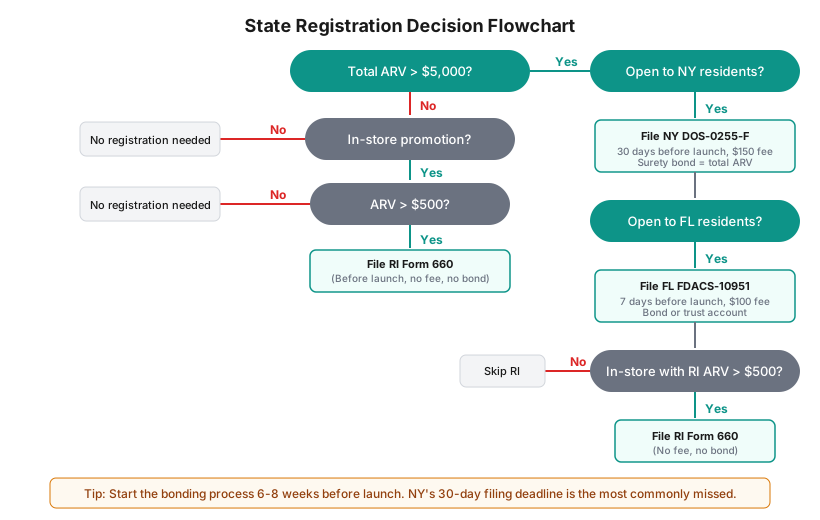
Three states in the United States require formal registration of sweepstakes promotions before they launch: New York, Florida, and Rhode Island. Each has its own forms, thresholds, timelines, and bonding requirements. If your promotion is open to residents of any of these states and your prize structure exceeds the relevant threshold, you must register.
New York
New York has the most demanding sweepstakes registration requirements in the country. The state's General Business Law, Article 29-A, governs "Games of Chance" in connection with the sale of consumer products and services. The New York Department of State administers the registration process.
Threshold. Registration is required when the total approximate retail value (ARV) of all prizes offered in the sweepstakes exceeds $5,000. This is the aggregate prize pool, not the value of any individual prize. If you are offering a grand prize of $3,000 and ten secondary prizes of $250 each, your total ARV is $5,500 and registration is required.
Registration form. You must file Form DOS-0255-F (Registration of Games of Chance) with the New York Department of State. The form requires detailed information about the sponsoring entity, the promotion period, prize descriptions and values, entry methods, and the method of winner selection.
Filing deadline. The registration must be filed at least 30 days before the promotion begins. This is the longest advance filing requirement of any state and is the deadline most commonly missed by brands. If you are planning a national promotion, New York's 30-day requirement should be one of the first items on your project timeline.
Filing fee. The current filing fee is $150, payable to the Department of State.
Surety bond. New York requires a surety bond filed on Form DOS-0261-F. The bond amount must equal the total retail value of all prizes offered in the promotion. This means that for a promotion with a $50,000 prize pool, you need a $50,000 surety bond. The bond guarantees that prizes will be awarded as described in the official rules.
Obtaining a surety bond is a separate process that typically involves working with a surety company or insurance broker. For most promotions, the premium (the amount you pay for the bond) runs between 1% and 3% of the bond amount, depending on the sponsor's creditworthiness. For a $50,000 bond, expect to pay between $500 and $1,500 in premium.
The bond must be in place before the registration is filed. Given that surety bond applications can take one to two weeks to process, you should begin the bonding process at least six to eight weeks before your planned launch date.
Winners list filing. After the promotion ends, you must file a list of all prize winners with the Department of State within 90 days. This is a mandatory post-promotion obligation that many brands overlook.
Enforcement. New York actively enforces its sweepstakes registration requirements. The Attorney General's office monitors national promotions and has pursued enforcement actions against brands that failed to register.
For a step-by-step walkthrough of the New York filing process, see our New York sweepstakes registration guide.
Florida
Florida's registration requirements are administered by the Florida Department of Agriculture and Consumer Services (FDACS) under Florida Statutes Chapter 849, Section 094. Florida's requirements are significant but somewhat less onerous than New York's, particularly in terms of the filing timeline.
Threshold. Like New York, Florida requires registration when the total ARV of all prizes exceeds $5,000.
Registration form. You must file Form FDACS-10951 (Game Promotion Registration). The form requires the sponsor's identity, a complete description of the promotion, prize details, entry methods, and the geographic scope of the promotion.
Filing deadline. The registration must be filed at least 7 days before the promotion begins. This is much more forgiving than New York's 30-day requirement, but it still requires advance planning. Do not assume you can file on launch day.
Filing fee. The filing fee is $100.
Surety bond or trust account. Florida requires the sponsor to establish either a surety bond or a trust account in an amount equal to the total value of all prizes offered. The trust account option provides an alternative for sponsors who have difficulty obtaining traditional surety bonds. The bond or trust must remain in effect until all prizes have been awarded and claimed.
Winners list. Florida does not require you to proactively file a winners list. However, you must provide a winners list to any person who requests one, and you must do so within 60 days of the request. Your official rules must disclose how to request the winners list.
Enforcement. FDACS has the authority to investigate complaints, conduct audits, and pursue civil penalties against non-compliant promotions. Florida is an active enforcement state, and its large consumer population means that complaints are common.
For a detailed breakdown of the Florida filing process, see our Florida sweepstakes registration guide.
Rhode Island
Rhode Island's sweepstakes registration requirements are narrower in scope than those of New York and Florida. The state's laws are found in Rhode Island General Laws, Title 11, Chapter 50, and are administered by the Department of Business Regulation.
Threshold. Registration is required when the total prize value exceeds $500. This is the lowest threshold of any state: a $500 prize pool is remarkably easy to exceed. However, the scope of Rhode Island's requirement is more limited than it might initially appear.
Scope. Rhode Island's registration requirement applies primarily to in-store and point-of-sale promotions: sweepstakes conducted at retail locations, on product packaging, or in connection with in-person purchases. Purely online sweepstakes are generally exempt from Rhode Island's registration requirement. The key distinction is whether the promotion has a physical retail component in Rhode Island.
This means that if you are running a purely digital sweepstakes with no in-store component, Rhode Island registration is typically not required, even if Rhode Island residents are eligible to enter. However, if your promotion includes any retail activation in Rhode Island (such as entry forms on product packaging sold in Rhode Island stores, in-store displays, or point-of-purchase materials), you should register.
Registration form. You must file Form 660 with the Department of Business Regulation.
Filing deadline. The registration must be filed before the promotion begins. There is no specific advance filing period mandated (unlike New York's 30-day requirement), but you should allow adequate processing time.
Bond. Rhode Island does not require a surety bond. This significantly reduces the administrative and financial burden compared to New York and Florida.
Fee. Filing fees are minimal.
For a full analysis of Rhode Island's requirements and how to determine whether your promotion triggers registration, see our Rhode Island sweepstakes registration guide.
For more on bonding requirements across all three registration states, see our sweepstakes bonding requirements guide.
States with Notable Secondary Requirements
Beyond the three registration states, a number of other states impose requirements that do not rise to the level of formal registration but are important enough to require attention in your compliance planning. These range from enhanced disclosure rules to consumer protection frameworks that give regulators broad authority over promotional practices.
California
California does not require sweepstakes registration, but it has some of the strongest consumer protection enforcement in the country. The California Business and Professions Code, Sections 17539-17539.5, imposes specific requirements on sweepstakes promotions:
- Mandatory disclosures. California requires that all sweepstakes materials clearly disclose the no-purchase-necessary entry method, the odds of winning (or a statement that odds depend on entries received), the geographic area covered, and the number of prizes to be awarded at each prize level.
- Rules availability. Official rules must be made available to any California resident upon request, without charge.
- Enhanced enforcement. The California Attorney General and local district attorneys actively pursue deceptive sweepstakes practices under the state's Unfair Competition Law (Business and Professions Code Section 17200). California's private attorney general statute also allows individuals to bring suit on behalf of the public, which creates additional litigation risk.
- Notification of winners. If your promotion has California participants, you should be prepared to provide the winners list promptly upon request.
California's combination of specific disclosure mandates and aggressive enforcement makes it one of the most important states to address in your compliance planning, even though no registration filing is required.
Maine
Maine occupies an unusual position in sweepstakes regulation. Under Maine Revised Statutes, Title 17, Section 332, the state requires registration for promotions that require a purchase to enter. For a properly structured sweepstakes with a free AMOE, this requirement should not technically apply: the defining characteristic of a legal sweepstakes is that no purchase is necessary.
However, Maine's interpretation can be broader than expected. If your promotion has a purchase-based entry method alongside the free AMOE, the Maine Attorney General's office may take the position that registration is required because a purchase pathway exists. The safest approach is to review your promotion structure carefully and consult counsel if your sweepstakes has a significant purchase-based entry component.
As a practical matter, most purely online sweepstakes with a standard mail-in AMOE do not trigger Maine registration. But if you are running a receipt-upload or product-purchase-based promotion with a mail-in AMOE, Maine deserves a closer look.
Arizona
Arizona does not require sweepstakes registration, but Arizona Revised Statutes Section 44-1722 imposes specific disclosure requirements:
- The odds of winning each prize must be clearly stated, or a clear statement that odds depend on the number of entries received.
- The retail value of each prize must be disclosed.
- The quantity of each prize to be awarded must be stated.
- The geographic area covered by the promotion must be identified.
- The date by which entries must be received must be clearly communicated.
Arizona's disclosure requirements are more prescriptive than those of many states. Failure to include these disclosures can result in enforcement action under Arizona's consumer fraud statutes. The good news is that well-drafted official rules will typically satisfy Arizona's requirements as a matter of course.
Maryland
Maryland's gaming laws can create unexpected overlap with sweepstakes promotions, particularly when a charitable organization is involved. Maryland Criminal Law, Title 12, governs gaming, and the state's charitable gaming provisions apply when a sweepstakes is conducted for the benefit of or in connection with a charitable organization.
If your sweepstakes involves a charitable component (for example, a portion of proceeds going to charity, or a nonprofit organization serving as a co-sponsor), Maryland's charitable gaming licensing requirements may apply. This is separate from standard sweepstakes law and involves a different set of permits and approvals.
For purely commercial sweepstakes with no charitable tie-in, Maryland's standard consumer protection framework applies without special registration. However, Maryland's Consumer Protection Division under the Attorney General is reasonably active in monitoring promotional practices.
Tennessee
Tennessee's sweepstakes advertising rules deserve specific attention. Tennessee Code Annotated, Title 47, Chapter 18, Part 1, addresses deceptive sweepstakes practices with particular focus on advertising and solicitation:
- Sweepstakes materials must not represent that the recipient has been "specially selected" or has won a prize, unless that is actually the case.
- Simulated checks, currency, or official-looking documents used in sweepstakes solicitations are subject to strict formatting requirements to prevent consumer confusion.
- The no-purchase-necessary disclosure must be displayed in type size at least as large as the largest type used for the prize description.
- Any materials that could give the false impression that a purchase improves the chance of winning are prohibited.
Tennessee's rules are primarily about advertising and presentation rather than registration. But violations can result in consumer protection enforcement actions, and the state's specificity about formatting and presentation means that your marketing materials need to be reviewed with Tennessee's requirements in mind.
Washington
Washington State does not require sweepstakes registration, but the Washington Consumer Protection Act (RCW 19.86) provides the Attorney General's office with broad authority to pursue unfair or deceptive practices, including promotional activities. Washington has been active in enforcing consumer protection standards in the digital space.
Key considerations for Washington include:
- All material terms must be clearly and conspicuously disclosed.
- The state takes an expansive view of what constitutes "deceptive" practices in promotional contexts.
- Washington's strong consumer protection enforcement means that complaints from Washington residents are more likely to result in regulatory action than in many other states.
- The Attorney General's office has pursued enforcement actions against national promotions that failed to meet Washington's disclosure standards.
Privacy-Forward States: Colorado, Connecticut, Utah, and Virginia
A newer category of state-level concern for sweepstakes operators involves state privacy laws. While these are not traditional "sweepstakes registration" requirements, they directly affect how you collect, use, and store participant data, which is a core function of every sweepstakes.
Colorado Privacy Act (CPA). Effective since July 2023, the CPA grants Colorado residents the right to opt out of data processing for targeted advertising and the sale of personal data. If your sweepstakes collects data from Colorado residents and you use that data for marketing purposes beyond the promotion itself, you must provide opt-out mechanisms and clear privacy disclosures. Sweepstakes entry forms that include marketing opt-ins must clearly separate consent for the promotion from consent for ongoing marketing.
Connecticut Data Privacy Act (CTDPA). Connecticut's privacy law mirrors many provisions of the CPA. It requires clear notice about data collection purposes, opt-out rights for targeted advertising and data sales, and data minimization principles. For sweepstakes operators, the practical implication is that you should only collect the data you genuinely need for the promotion and clearly disclose any secondary uses.
Utah Consumer Privacy Act (UCPA). Utah's law is somewhat narrower than Colorado's and Connecticut's, with higher thresholds for applicability. But if your organization meets the revenue and data-processing thresholds, the same principles apply: clear disclosure, purpose limitation, and opt-out rights for data sales and targeted advertising.
Virginia Consumer Data Protection Act (VCDPA). Virginia was one of the earliest states (after California) to enact broad privacy legislation. The VCDPA requires clear and accessible privacy notices, purpose limitation, data minimization, and consumer rights to access, correct, and delete personal data.
For sweepstakes operators, these privacy laws create a practical requirement: your entry form, official rules, and privacy policy must clearly disclose what data you collect, why you collect it, how you use it, and how participants can exercise their privacy rights. If you use sweepstakes data for retargeting, email marketing, or any purpose beyond administering the promotion, you need explicit consent mechanisms that comply with these states' laws.
These requirements apply based on where your participants reside, not where your business is located. A sweepstakes open to all 50 states must account for all four privacy frameworks.
States with No Significant Additional Requirements
The majority of U.S. states follow the federal baseline for sweepstakes regulation. They do not require advance registration, bonding, or state-specific filings. In these states, compliance means adhering to the core principles: provide a free AMOE, publish complete and accessible official rules, clearly disclose material terms, select winners as described in the rules, award prizes as promised, and meet tax reporting obligations (1099-MISC for prizes of $2,000 or more in 2026).
"No registration required" does not mean "no rules apply." A well-structured sweepstakes with proper official rules and transparent practices will be compliant in these states as a matter of course.
States in this category include, among others: Alabama, Alaska, Arkansas, Delaware, Georgia, Hawaii, Idaho, Illinois, Indiana, Iowa, Kansas, Kentucky, Louisiana, Michigan, Minnesota, Mississippi, Missouri, Montana, Nebraska, Nevada, New Hampshire, New Jersey, New Mexico, North Carolina, North Dakota, Ohio, Oklahoma, Oregon, Pennsylvania, South Carolina, South Dakota, Texas, Vermont, West Virginia, Wisconsin, and Wyoming.
Each of these states still has general consumer protection statutes that can be invoked if a promotion is deceptive or unfair.
Which States' Laws Apply to Your Promotion?
One of the most common misconceptions in sweepstakes compliance is the belief that the applicable law is determined by where the sponsor is located. This is incorrect. State sweepstakes laws apply based on where the participants reside, not where the sponsor is headquartered, where the servers are located, or where the prize drawing takes place.
This principle has critical practical implications:
An online sweepstakes open to all 50 states triggers every state's laws. If your sweepstakes is available nationwide and your total prize ARV exceeds $5,000, you must register in both New York and Florida. Running a national promotion without NY registration is a serious compliance risk. You must also comply with California's disclosure requirements, Arizona's odds disclosure rules, and every other state's applicable regulations.
Restricting eligibility is the only way to avoid a state's requirements. If you do not want to comply with New York's registration requirements, the only reliable approach is to exclude New York residents from eligibility. This must be clearly stated in your official rules and technically enforced (to the extent possible) in your entry process.
"Void where prohibited" is not a substitute for state-by-state analysis. As we discuss in our void where prohibited guide, this catch-all clause does not exempt you from registration requirements. If you offer the sweepstakes to New York residents, you must register in New York, regardless of what your rules say about voiding the promotion.
The sponsor's location determines governing law for disputes, not compliance obligations. You can specify in your official rules that disputes will be governed by the laws of your home state. But this does not change your obligation to comply with the consumer protection and registration laws of every state where participants reside.
Practical Compliance Checklist for Multi-State Promotions
Running a sweepstakes across multiple states requires systematic planning. Use this checklist and timeline to ensure you meet every obligation.
Phase 1: Assessment (8-6 Weeks Before Launch)
- Calculate total ARV. Add up the approximate retail value of every prize you plan to offer, including all prize tiers. This number determines whether registration is required.
- Define eligible states. Decide whether the promotion will be open to all 50 states or a subset. If you plan to exclude any states, document the rationale.
- Identify registration obligations. If your total ARV exceeds $5,000 and the promotion is open to New York and/or Florida residents, you must register. If it exceeds $500 and includes in-store activation in Rhode Island, you must register there as well.
- Identify bonding requirements. New York and Florida both require surety bonds (or, in Florida's case, a trust account alternative). Contact a surety company or insurance broker to begin the application process.
- Review state-specific disclosure requirements. Ensure your official rules and promotional materials will satisfy California, Arizona, Tennessee, and other states with specific disclosure mandates.
- Assess privacy law obligations. If the promotion collects personal data from residents of California, Colorado, Connecticut, Utah, or Virginia, ensure your data practices comply with each state's privacy framework.
Phase 2: Filing and Preparation (6-2 Weeks Before Launch)
- File New York registration (30+ days before launch). Submit Form DOS-0255-F and Form DOS-0261-F (surety bond) to the Department of State, along with the $150 filing fee. Allow extra time for processing.
- Draft official rules. Ensure rules include all required disclosures for every eligible state. Include AMOE details, prize descriptions with ARV, odds statements, and state-specific provisions.
- Finalize surety bond. Confirm that the bond is issued and in place before filing registrations. The bond amount must equal the total prize value.
- Set up AMOE processing. Establish the mail-in address, designate personnel to process AMOE entries, and create a logging system that gives AMOE entries the same treatment as online entries.
Phase 3: Final Filings (2-1 Weeks Before Launch)
- File Florida registration (7+ days before launch). Submit Form FDACS-10951 to the Department of Agriculture and Consumer Services, along with the $100 filing fee and proof of bond or trust account.
- File Rhode Island registration if applicable. Submit Form 660 to the Department of Business Regulation if your promotion includes in-store activation in Rhode Island and the total prize value exceeds $500.
- Legal review. Have qualified legal counsel review the final official rules, entry form, and promotional materials.
- Internal compliance check. Verify that all promotional materials (website, social media posts, email campaigns, in-store signage) include the required disclosures and no-purchase-necessary language.
Phase 4: During the Promotion
- Process AMOE entries consistently. AMOE entries must be logged and given the same chance of winning as paid or online entries. Delays or inconsistencies in AMOE processing can create legal exposure.
- Monitor for compliance issues. Watch for consumer complaints, entry irregularities, and any state regulatory inquiries.
- Maintain records. Keep detailed records of all entries, winner selections, prize fulfillments, and communications.
Phase 5: Post-Promotion Obligations
- Select and verify winners. Follow the winner selection process described in your official rules exactly.
- Collect W-9 forms. For prizes valued at $2,000 or more, collect W-9 forms from winners and issue 1099-MISC forms.
- File New York winners list. Submit the list of all prize winners to the New York Department of State within 90 days after the promotion ends.
- Prepare Florida winners list. You are not required to proactively file in Florida, but you must provide the winners list within 60 days of any request. Have the list ready.
- Fulfill prizes. Deliver all prizes within the timeframe stated in your official rules.
- Retain records. Keep all promotion records for at least 4 years. Statutes of limitations vary by state, and regulatory inquiries can come well after a promotion ends.
How Comprizant Helps with State Compliance
The compliance framework described above is extensive, and managing it manually for every promotion is time-consuming, error-prone, and expensive. This is the problem Comprizant was built to solve.
When you create a campaign in Comprizant and define your prize structure, the platform flags which state registration obligations may apply:
Automatic threshold detection. Comprizant calculates your total ARV across all prize tiers and flags when you cross the $5,000 threshold (triggering New York and Florida registration) or the $500 threshold (triggering Rhode Island registration for in-store promotions).
Filing timeline generation. Based on your planned launch date, Comprizant generates a compliance timeline that accounts for New York's 30-day advance filing requirement, Florida's 7-day requirement, and bonding lead times. You see exactly when each filing must be completed.
State-specific draft rules. Comprizant's rules engine generates draft official rules that include disclosures for every state where your promotion is available. California's specific disclosure requirements, Arizona's odds disclosures, Tennessee's advertising rules: each is built into the drafts based on your eligible states.
Privacy compliance integration. For promotions that collect data from residents of privacy-forward states, Comprizant helps you build entry forms and privacy disclosures that address the requirements of the CPA, CTDPA, UCPA, and VCDPA.
Bonding requirement alerts. When your prize structure triggers bonding requirements, Comprizant calculates the required bond amount and alerts you with enough lead time to complete the surety bond application process.
Post-promotion tracking. After your promotion ends, Comprizant tracks post-promotion obligations including the New York winners list filing deadline (90 days) and prepares the Florida winners list for on-demand delivery (60-day response window).
The goal is not to replace legal counsel. It is to keep the routine compliance mechanics consistent and trackable, so your legal team can focus on the strategic questions that require human judgment.
Key Takeaways
-
Three states require formal registration: New York ($5,000+ ARV, 30-day advance filing, surety bond), Florida ($5,000+ ARV, 7-day advance filing, bond or trust), and Rhode Island ($500+ ARV, in-store promotions, no bond).
-
New York's 30-day filing deadline is the most commonly missed requirement. Build it into your project timeline from day one.
-
Surety bonds take time. Start the bonding process six to eight weeks before launch to avoid delays.
-
Several states have important secondary requirements. California's enforcement posture, Arizona's disclosure rules, Tennessee's advertising standards, and four states' privacy laws all require attention.
-
State laws apply based on participant residency, not sponsor location. An online sweepstakes open nationwide triggers every state's requirements.
-
"Void where prohibited" does not replace compliance. It is a backup clause, not a strategy.
-
Post-promotion obligations are enforceable. New York's 90-day winners list filing and Florida's 60-day request response window are legal requirements, not suggestions.
-
Automation reduces risk. Manually tracking state requirements across multiple promotions is where compliance failures occur. Systematic, automated detection reduces the most common errors.
Ready to stop worrying about state-by-state compliance and focus on running great promotions? Get started with Comprizant: automated registration detection, state-specific draft rules, and compliance timelines built into every campaign.