How to Run a Multi-State Sweepstakes Without Getting Sued
Running a sweepstakes across multiple states triggers overlapping registration, bonding, and disclosure requirements. Learn how to navigate multi-state compliance, manage timelines, and avoid the most common mistakes.
Running a sweepstakes open to residents of multiple states is one of the most common promotional strategies in the United States, and one of the most legally complex. The moment you invite participants from more than one state, you are subject to each state's promotional laws simultaneously. There is no federal sweepstakes statute that preempts state requirements, no single filing that covers the entire country, and no shortcut that eliminates the need for state-by-state analysis.
Most brands run national promotions open to all 50 states plus the District of Columbia. This triggers the full spectrum of compliance obligations: registration in states that require it, bonding where mandated, state-specific disclosures in your official rules, and post-promotion obligations that vary by jurisdiction. Failing to meet any of these requirements can result in regulatory action, civil penalties, or private litigation, even if you complied perfectly in every other state.
What follows walks through the entire multi-state compliance process, from determining which laws apply to managing post-promotion obligations after the last prize is awarded.
This article is for informational purposes only and does not constitute legal advice. Consult with a qualified attorney for guidance specific to your promotion.
The Multi-State Challenge
When you open a sweepstakes to residents of multiple states, you are not choosing one set of rules to follow. You are layering every participating state's laws on top of each other. Each state has its own consumer protection statutes, and sweepstakes promotions touch several of them: deceptive trade practices, consumer protection, gaming and lottery laws, and specific promotional contest statutes.
The challenge is not that any single state's requirements are impossibly difficult. Taken individually, New York's registration process is manageable. Florida's filing is straightforward. Rhode Island's requirement is narrow. The challenge is managing all of them simultaneously, on overlapping timelines, with rules that must satisfy every jurisdiction at once.
Consider a consumer packaged goods brand launching a national sweepstakes with a $50,000 total prize pool. That single promotion triggers registration in New York (prize value exceeds $5,000), registration in Florida (same threshold, different forms, different timeline), and potentially registration in Rhode Island (if the promotion includes any in-store component, at a $500 threshold). It also requires surety bonds in New York and Florida, state-specific disclosures (New York registration number, Florida bond information, California enhanced prize disclosures), post-promotion winners list filings to New York (within 90 days) and Florida (within 60 days of request), and tax reporting for prizes at or above the reporting threshold.
Miss any one of these, and you have created legal exposure in that jurisdiction, regardless of how perfectly you handled the other 49 states. This is where most national promotions get into trouble: not by ignoring compliance entirely, but by missing one requirement in one state.
Which State's Laws Apply
A common misconception is that the sponsor's home state governs the sweepstakes. It does not. Another misconception is that the state where the server is hosted, or where the prize is shipped from, determines jurisdiction. It does not.
The governing principle is participant residency. Each participant is protected by their home state's laws. A sponsor incorporated in Texas, hosting its website on servers in Virginia, running a sweepstakes open to all 50 states, must comply with the laws of every state where a participant resides, including New York, Florida, Rhode Island, California, and every other state with relevant requirements.
This means that the compliance analysis starts with a simple question: which states are eligible? If the answer is "all 50 states plus DC," then you must review the requirements of every jurisdiction. If you limit eligibility to specific states, you only need to comply with those states' laws, but you must clearly disclose the geographic limitations in your official rules.
The Practical Implication
Because participant residency determines jurisdiction, you cannot avoid a state's requirements by structuring the promotion in a particular way. You cannot host the website outside of New York to avoid New York law. You cannot ship prizes from a state with no registration requirement and claim that state's law applies. If New York residents can enter, New York law applies.
The only way to avoid a state's requirements is to exclude that state's residents from eligibility, and even that requires clear, prominent disclosure.
State Registration Deep Dive
Three states currently require advance registration of sweepstakes promotions that exceed specified prize value thresholds. Each has its own forms, timelines, thresholds, and procedures. For a comprehensive overview, see our state-by-state registration guide.
New York
New York has the most demanding registration requirements in the country:
- Threshold: Total Approximate Retail Value (ARV) of all prizes exceeds $5,000
- Filing deadline: At least 30 calendar days before the promotion start date
- Required form: DOS-0255-F (Games of Chance Registration)
- Surety bond: Required, equal to the total value of all prizes offered (filed on form DOS-0261-F)
- Filing fee: None
- Post-promotion: Winners list must be filed with the Department of State within 90 days of the promotion end date
The 30-day advance filing requirement is the most significant constraint for multi-state promotions because it drives the entire compliance timeline. You cannot begin a national sweepstakes until New York's 30-day period has elapsed, which means your compliance work must start well before that.
For detailed instructions on the New York filing process, see our New York sweepstakes registration guide.
Florida
Florida's requirements are similar to New York's in scope but differ in specifics:
- Threshold: Total ARV of all prizes exceeds $5,000
- Filing deadline: At least 7 calendar days before the promotion start date
- Required form: FDACS-10951 (Game Promotion Registration)
- Surety bond or trust account: Required, equal to the total prize value
- Filing fee: $100
- Post-promotion: Must provide a winners list within 60 days of receiving a request
Florida's shorter advance filing deadline (7 days vs. New York's 30) gives more flexibility, but the bonding requirement adds its own timeline considerations. The filing fee is modest, but the bond or trust account represents a real financial commitment.
For detailed instructions, see our Florida sweepstakes registration guide.
Rhode Island
Rhode Island's registration requirement is narrower but catches promotions that many sponsors do not expect:
- Threshold: Total ARV exceeds $500, the lowest threshold of any state
- Scope: Applies specifically to promotions with an in-store component (coupon redemption, in-store entry, retail displays)
- Required form: Form 660 (Promotional Games of Chance Registration)
- Filing deadline: Before the promotion begins (no specific advance period)
- Bond: Not required
- Filing fee: $150
Rhode Island's $500 threshold means that even modest in-store promotions trigger registration. However, purely online promotions with no retail component generally do not require Rhode Island registration. The determination depends on whether any element of the promotion occurs at a physical retail location within Rhode Island.
For detailed instructions, see our Rhode Island sweepstakes registration guide.
Bonding Across States
Both New York and Florida require surety bonds (or, in Florida's case, a trust account as an alternative) as part of the registration process. This raises a practical question: can you use a single bond to satisfy both states' requirements?
Generally, no. Each state's bonding requirement is independent. The New York bond is filed with the New York Department of State on form DOS-0261-F. The Florida bond or trust account is filed with the Florida Department of Agriculture and Consumer Services. Each bond is a separate instrument with its own terms, conditions, and release procedures.
For a comprehensive overview of bonding mechanics, costs, and alternatives, see our sweepstakes bonding requirements guide.
Bond Costs
Surety bonds for sweepstakes typically cost between 1% and 3% of the bond amount (which equals the total prize value). The exact premium depends on:
- The principal's creditworthiness: stronger credit means lower premiums
- The bond amount: higher prize values may command lower percentage rates
- The surety company: rates vary between providers
- The promotion duration: longer promotions may cost more
For a sweepstakes with a $50,000 total prize pool, expect bond costs in the range of $500 to $1,500 per state. For a $500,000 prize pool, costs scale accordingly: $5,000 to $15,000 per state.
Bond Application Timeline
Bond applications typically take 2 to 4 weeks to process, depending on the surety company and the complexity of the application. This timeline must be factored into your overall compliance calendar. If you need a bond filed with New York 30 days before your promotion starts, and the bond application takes 3 weeks, you need to begin the bonding process at least 7 to 8 weeks before launch.
Bond Release
After the promotion ends and all prizes have been awarded and delivered, the bond can be released. In New York, this requires confirmation from the Department of State, typically after the winners list has been filed and reviewed. In Florida, the release process follows confirmation that all prize obligations have been fulfilled.
Bond release is not automatic. You must actively request it, and the surety company will not cancel the bond until the state confirms that all obligations are satisfied. During this period, you remain liable for the bond premium.
Official Rules for Multi-State Promotions
The official rules for a multi-state sweepstakes must be comprehensive enough to satisfy the requirements of every participating state simultaneously. This does not mean you need separate rules for each state (a single set of rules can work), but the rules must include state-specific provisions where required.
State-Specific Provisions
Several states require specific disclosures or provisions in the official rules:
- New York: Must include the registration number assigned by the Department of State. Must disclose that a bond has been filed.
- Florida: Must include disclosure of the bond or trust account. Must state that the promotion is registered with the Florida Department of Agriculture and Consumer Services.
- California: Enhanced prize disclosures, including the odds of winning and the retail value of each prize. California Business and Professions Code Section 17539 sets specific disclosure requirements.
- Other states: Various states have requirements around eligibility disclosures, entry limits, and odds of winning.
The standard approach is to include a "State-Specific Disclosures" section in your official rules that addresses each state's requirements. This keeps the main body of the rules clean.
For a complete guide to drafting official rules, see our sweepstakes official rules guide.
"Void Where Prohibited" Is Not a Compliance Strategy
Many brands include the phrase "void where prohibited" in their official rules and assume this provides blanket protection against state-specific requirements. It does not.
"Void where prohibited" is a useful supplement: it communicates to participants in states with unusual restrictions that the promotion may not be available to them. But it does not relieve the sponsor of the obligation to actually determine where the promotion is prohibited, comply with requirements in states where it is legal, and affirmatively exclude states where it is not.
A state regulator reviewing your promotion will not accept "void where prohibited" as a substitute for registration, bonding, or required disclosures. If your promotion is open to residents of a state that requires registration, you must either register or explicitly exclude that state from eligibility, not merely wave a hand with a boilerplate phrase.
For more on this topic, see our guide on void where prohibited and state restrictions.
The Exclude-or-Comply Decision
For each state that imposes additional requirements (registration, bonding, special disclosures), brands face a binary decision: comply with that state's requirements, or exclude that state's residents from eligibility.
This is not a legal judgment call that can be made generically. It depends on several factors specific to your promotion:
Cost of Compliance
Registration and bonding costs are real but often modest relative to the overall promotion budget. For a sweepstakes with a $50,000 prize pool:
- New York registration: no filing fee, plus bond premium of $500-$1,500
- Florida registration: $100 filing fee, plus bond premium of $500-$1,500
- Rhode Island registration: $150 filing fee, no bond required
Total compliance cost for all three states: approximately $1,250 to $3,250. For a promotion with a $50,000 prize pool and associated marketing spend, this is typically a rounding error.
Marketing Reach
Excluding a state means losing access to that state's population. New York has approximately 19.5 million residents. Florida has approximately 22.6 million. Excluding either state from a national promotion means cutting a significant percentage of your addressable market.
Rhode Island, with approximately 1.1 million residents, represents a smaller marketing opportunity. For purely online promotions that do not trigger Rhode Island's in-store requirement, the question is moot. For promotions with an in-store component, the cost-benefit analysis is closer.
Risk Tolerance
Some brands take the position that the risk of enforcement in a given state is low enough to justify non-compliance. This is a dangerous approach. State attorneys general and consumer protection agencies have become increasingly active in sweepstakes enforcement, and the penalties for non-compliance can significantly exceed the cost of compliance.
Common Approach
Most national brands comply with New York and Florida (the cost is manageable and the population loss from exclusion is unacceptable) and evaluate Rhode Island on a case-by-case basis depending on whether the promotion has an in-store component.
Brands with smaller budgets or regional focus may choose to exclude one or more states. If you do, the exclusion must be clearly stated in the official rules and prominently disclosed in all promotional materials.
Timeline Management
The single most important timeline constraint for a multi-state sweepstakes is New York's 30-day advance registration requirement. This deadline anchors the entire compliance calendar and forces early planning.
Recommended Timeline: 8 Weeks Before Launch
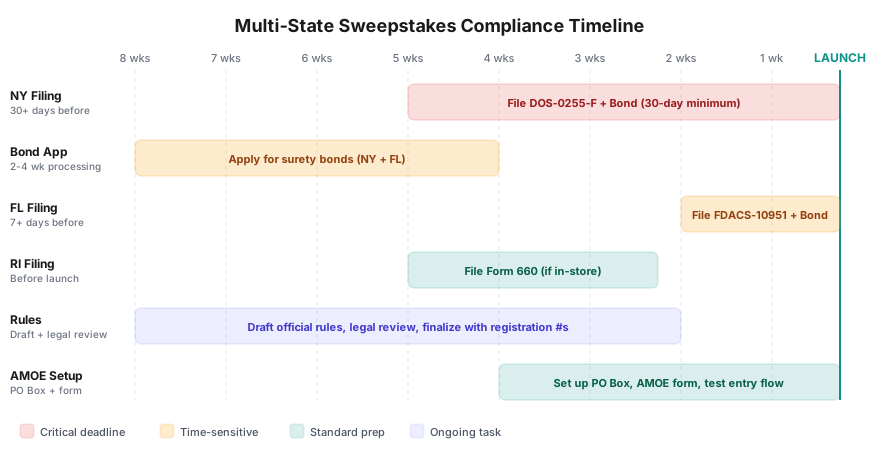
Here is a practical timeline for a national sweepstakes with a total prize value exceeding $5,000:
Week 1-2: Planning and Analysis
- Determine eligible states and total prize value
- Identify which states require registration, bonding, or special disclosures
- Make exclude-or-comply decisions for each state
- Engage legal counsel for rules review
- Begin surety bond applications for New York and Florida
Week 3-4: Drafting and Bond Processing
- Draft official rules with state-specific provisions
- Complete surety bond applications
- Prepare registration forms (DOS-0255-F for NY, FDACS-10951 for FL, Form 660 for RI)
- Collect supporting documentation (corporate authorization, promotion details)
Week 5: Filing
- File New York registration package (at least 30 days before launch)
- File Rhode Island registration if applicable
- Confirm bond issuance for New York and Florida
Week 6-7: Confirmation and Final Preparation
- Confirm New York registration acceptance and obtain registration number
- File Florida registration (at least 7 days before launch)
- Finalize official rules with registration numbers and bond disclosures
- Publish official rules on promotion website
Week 8: Launch
- Verify all registrations are confirmed
- Verify official rules include all required disclosures
- Launch promotion
Why 30 Days Is Not Enough
Starting compliance work only 30 days before launch, to meet New York's minimum, leaves no margin for error. Bond applications can take 2 to 4 weeks. Registration forms may be returned for corrections. Legal review of official rules takes time. If any step encounters a delay, you either miss your launch date or launch without proper compliance.
Starting 8 weeks before launch gives you buffer for every step and avoids the panicked scramble that leads to mistakes.
Post-Promotion Obligations by State
Compliance does not end when the promotion closes. Each state with registration requirements also has post-promotion obligations that must be fulfilled.
Winners List Filings
New York requires the sponsor to file a winners list with the Department of State within 90 days after the promotion ends. The winners list must include the names and addresses of all prize winners. Failure to file the winners list can delay bond release and may result in enforcement action.
Florida requires the sponsor to provide a winners list within 60 days of receiving a written request from the Department of Agriculture and Consumer Services or from any Florida resident who requests it. The winners list must include the names and addresses of all winners of prizes valued at $25 or more.
Rhode Island does not have a specific winners list filing requirement, but sponsors must maintain records of the promotion for inspection by the Department of Business Regulation.
Tax Reporting
For 2026, the IRS reporting threshold for sweepstakes prizes is $2,000. For any prize with a fair market value at or above this threshold, the sponsor must:
- Collect a completed W-9 form from the winner before delivering the prize
- Issue a 1099-MISC to the winner and the IRS for the tax year in which the prize was awarded
- Track cumulative winnings per participant: if a single person wins multiple smaller prizes that total $2,000 or more, reporting is still required
Tax reporting is a federal obligation, not state-specific, but it is part of the post-promotion workflow that must be planned for in advance. Winners who refuse to provide a W-9 are typically disqualified under the official rules.
Record Retention
Maintain complete records of the promotion for a minimum of 3 to 4 years after the promotion ends. Records should include:
- Official rules (all versions, including any amendments)
- Registration filings and confirmation receipts
- Bond documentation
- All entries received
- Winner selection methodology and results
- Winner notification records
- Prize fulfillment records
- Winners list filings
- Tax documentation (W-9s, 1099-MISC copies)
These records may be needed for regulatory inquiries, audits, consumer complaints, or litigation.
Common Mistakes in Multi-State Sweepstakes
Having reviewed the requirements, here are the mistakes that brands make most frequently, and how to avoid them.
Starting Compliance Too Late
This is the most common mistake by a wide margin, and the most preventable. Brands finalize their promotion concept, design the creative, build the website, and then ask "what about compliance?" two weeks before launch. By that point, New York's 30-day deadline has already passed, bond applications cannot be completed in time, and the team faces an impossible choice between delaying launch or launching non-compliant.
Solution: Begin compliance planning the moment the promotion concept is approved. Build compliance timelines into the project plan from day one.
Assuming Online-Only Exempts You from State Laws
Some brands believe that running an online-only sweepstakes (no retail presence, no physical mailings, no in-store displays) exempts them from state registration requirements. This is incorrect. New York and Florida registration requirements apply based on prize value, not promotion format. An online-only sweepstakes with a $50,000 prize pool triggers the same registration requirements as an in-store promotion.
The one exception is Rhode Island, where the registration requirement is triggered specifically by in-store promotional games of chance. A purely online promotion with no retail component generally does not require Rhode Island registration.
Using "Void Where Prohibited" as a Compliance Strategy
As discussed above, "void where prohibited" does not replace actual compliance. It is a disclosure, not a shield. If you have not identified which states prohibit your promotion and have not either complied with or excluded those states, the phrase provides no meaningful protection.
Not Tracking Cumulative Prize Value
Some brands structure promotions as multiple smaller sweepstakes to stay under the $5,000 registration threshold. This can work if the promotions are genuinely separate (different entry pools, different prize pools, different official rules). But if they are structured as phases of a single promotion, regulators may aggregate the prize values, pushing the total above the threshold.
Track cumulative prize value across all promotions running concurrently or as part of a related campaign. If the aggregate exceeds state thresholds, registration may be required.
Inconsistent Entry Limits Across States
If your official rules allow different entry limits for residents of different states, you are creating a legal risk. Sweepstakes must generally provide equal treatment to all eligible participants. State-specific entry limits raise questions about whether the promotion is being conducted fairly and whether the odds disclosures are accurate.
The safer approach is to set uniform entry limits for all eligible participants and to adjust your overall compliance approach rather than creating state-by-state exceptions.
Not Planning for Post-Promotion Obligations
Compliance does not end when the promotion closes. Winners lists must be filed, bonds must be released, tax documents must be issued, and records must be retained. Brands that treat the promotion end date as the end of their compliance obligations are setting themselves up for regulatory problems.
Build post-promotion obligations into your project plan with specific deadlines and responsible parties.
Compliance Considerations
Running a multi-state sweepstakes requires attention to several compliance dimensions simultaneously.
Registration timing is inflexible. New York's 30-day requirement and Florida's 7-day requirement are statutory deadlines: missing them means either delaying the promotion or launching non-compliant. Bonding is a real financial commitment that must be factored into your promotion budget from the beginning. And a single set of official rules must satisfy every participating state's disclosure requirements; state-specific sections are not optional, they are legally required where applicable.
Post-promotion obligations have hard deadlines too. Winners list filings, tax reporting, and record retention are legal requirements, not administrative housekeeping. The exclude-or-comply decision has marketing consequences: excluding New York or Florida to avoid compliance costs means losing access to millions of potential participants. The compliance cost is almost always lower than the marketing cost of exclusion. And enforcement is real: state attorneys general and consumer protection agencies actively investigate sweepstakes promotions.
How Comprizant Helps with Multi-State Compliance
Comprizant provides tools for the most complex aspects of multi-state sweepstakes compliance:
Automatic state requirement detection. When you configure your promotion's eligible states and total prize value, Comprizant identifies which states require registration, bonding, or special disclosures, and flags them in your compliance dashboard.
Filing timeline generation. Based on your target launch date and the applicable states, Comprizant generates a compliance timeline that works backward from launch, accounting for New York's 30-day requirement, bond application lead times, and Florida's 7-day filing deadline.
Form pre-filling. Comprizant pre-fills registration forms for New York (DOS-0255-F), Florida (FDACS-10951), and Rhode Island (Form 660) using your promotion data: sponsor information, prize descriptions, prize values, promotion dates, and official rules details.
State-specific rules provisions. When generating official rules, Comprizant automatically includes state-specific disclosure sections for each state that requires them, including New York registration numbers, Florida bond disclosures, and California prize value disclosures.
Post-promotion obligation tracking. After your promotion ends, Comprizant tracks winners list filing deadlines, bond release procedures, and tax reporting requirements so nothing falls through the cracks.
Key Takeaways
- Participant residency determines jurisdiction. If residents of a state can enter your sweepstakes, that state's laws apply, regardless of where you are located or where your servers are hosted.
- Three states require registration (New York and Florida at $5,000 ARV, Rhode Island at $500 for in-store promotions), and each has its own forms, timelines, and bonding requirements.
- Start compliance 8 weeks before launch. New York's 30-day advance filing requirement, combined with bond application timelines, means late starts lead to missed deadlines or non-compliant launches.
- "Void where prohibited" is a disclosure, not a compliance strategy. You must actually determine where your promotion is prohibited, comply where required, and exclude where you choose not to comply.
- Post-promotion obligations are legally binding. Winners list filings, tax reporting, and record retention have specific deadlines and cannot be skipped.
- The cost of compliance is almost always less than the cost of exclusion or enforcement. Registration fees, bond premiums, and legal review are modest relative to the marketing value of a national promotion.
Ready to Launch a Multi-State Sweepstakes?
Comprizant helps with the complexity of multi-state compliance so you can focus on running a great promotion. Automatic state detection, form pre-filling, timeline management, and post-promotion tracking, all in one platform.